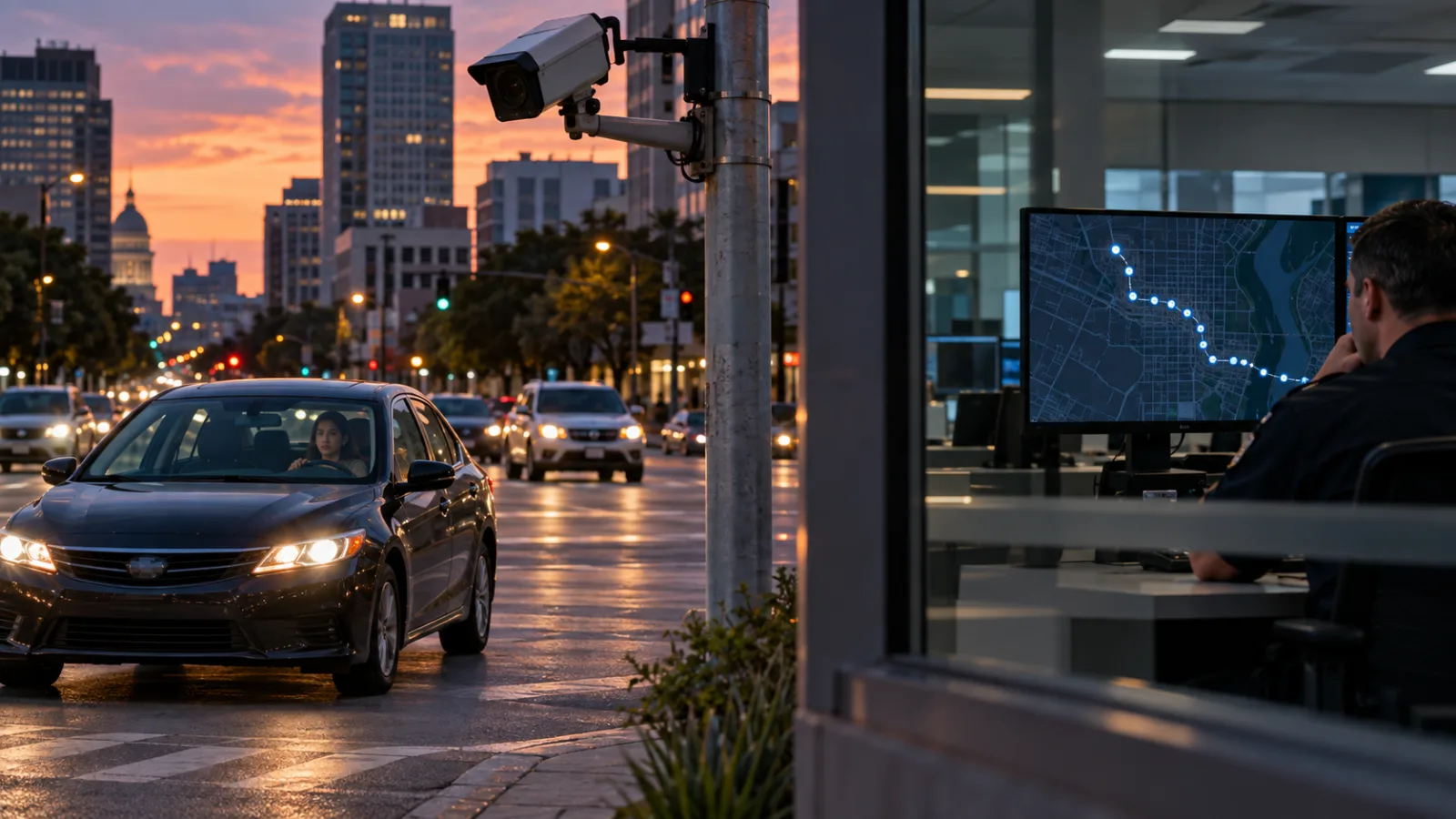
You’re just driving to work.
Passing through an intersection.
Going to the supermarket.
Heading to the gym.
Driving back home.
You might not even notice,
a small camera by the roadside,
has already recorded:
your license plate.
your vehicle.
the time you passed through.
and your location.
This system was originally designed to help the police solve cases.
But now, a very different story is unfolding in Indianapolis, USA.
Five police officers stand accused of using the department’s license plate recognition system for personal inquiries.
Some are even charged with using this data to track women.
Originally meant to find stolen vehicles, now it’s used to track ‘where people are’
On September 23,
five officers from the Indianapolis Metropolitan Police Department were criminally charged.
The case involves Flock Safety’s automated license plate recognition system, also known as ALPR.
Four are active officers, and one is a former officer.
Prosecutors allege these individuals used a system intended solely for law enforcement work
to look up the locations of ex-partners, spouses, acquaintances, and even women they encountered in public.
These remain charges and do not indicate convictions.
However, the pattern of searches revealed by prosecutors already makes the case quite unusual.
One officer allegedly stalked women after checking their locations
Among those charged,
Jonathan Schultz, an 18-year veteran officer,
faces 26 counts, including fraud, misconduct,
and two counts related to stalking.
Prosecutors claim he used Flock data to locate several women’s cars,
including those he encountered in public places.
Crucially,
he isn’t accused of just searching data behind a computer.
He allegedly used the location information he found to arrange in-person “encounters.”
Because of this behavior,
he is the only one in the case facing stalking charges.
At this point,
the abstract concept of “data privacy”
suddenly becomes very tangible.
A spot on a map in the database might reveal:
where you went today,
when you were there,
and which way your car went.
Another number is more direct: More than 950 times
Another accused officer,
is said by investigators to have checked his ex-wife’s vehicle location over 950 times in about six months.
What does 950 times mean?
On average,
this is far more than just an occasional glance.
It means repeatedly knowing the same vehicle’s:
appearances,
times,
and most recent whereabouts.
When this kind of data can be accessed in seconds,
the issue is no longer:
“Can the system do this?”
It becomes:
“Who is allowed to do this?”
and
“Why are they doing this?”
What exactly can Flock see?
Flock Safety’s system doesn’t just take a single photo of a license plate.
Official documents state the License Plate Reader can record:
license plate images,
vehicle images,
plate number and state,
vehicle color, make, and other features,
date,
time,
and camera location.
Flock also uses machine learning to identify vehicle characteristics.
For example:
whether it’s a sedan or SUV,
the color,
presence of a roof rack,
and even,
when a full license plate number isn’t known,
it can search by vehicle features.
Now, Flock offers FreeForm,
allowing authorized users to search vehicles and related images using natural language queries.
The company calls this an AI-powered search.
So it’s accurate to say it’s an AI/machine learning-enhanced system for license plate and vehicle searches.
But there’s one crucial point to keep separate in this case.
AI isn’t stalking people on its own
This case should not be written as:
“AI decided to stalk women on its own.”
At least based on current public information, that’s not the case.
The accused are instead:
people with system access who actively input queries, search vehicle records, and then use the results for non-official purposes.
The AI and machine learning do this:
make vast amounts of vehicle images easier to identify,
easier to categorize,
and easier to search.
But the person actually pressing “search”
is still a human.
This distinction is very important.
Because the problem isn’t just “Is AI safe?”
It’s whether
permission controls keep pace with how AI makes a formerly difficult task doable in seconds.
Tracking a car used to be complicated
Without such a system,
tracking a car’s location long-term
usually required significant manpower.
Someone would have to stake out by the roadside.
Someone else would review surveillance footage.
Searching through videos piece by piece,
then piecing together records from different places.
The cost was very high.
That’s why,
only more important cases
justified the effort.
But when road cameras automatically detect license plates,
and organize:
plate numbers,
times,
locations,
and vehicle characteristics
into searchable data,
the cost of looking something up drops dramatically.
This is very useful for catching stolen cars.
For that reason, Flock lists finding stolen vehicles, locating missing persons, and investigating crimes as primary uses.
But the easier it gets to do this,
the lower the threshold for abuse becomes.
Flock keeps an audit log of searches
This issue can’t be simplified to:
“The system had no oversight.”
Flock states clearly that
there is a per-search audit log.
Meaning every search leaves a recorded trail.
In this case,
the investigation began after an internal police audit discovered unusual usage patterns.
After the incident became public,
the Indianapolis Police Department changed the rules:
now each Flock search must be linked to a specific case or event number.
In other words,
you can’t just open the system and search:
“Where is this car now?”
Instead, you have to record:
“I need to look this up for this specific case.”
This seems like a simple added field,
but it’s actually a critical layer in permissions management.
The real question isn’t “Can it be done?” but “Should it be done?”
Recently, when discussing AI,
we often ask:
What can it do?
How much data can it access?
How fast can it find things?
How much can it automate?
But as tools become more powerful,
another question grows equally important:
Just because a user can do something doesn’t mean they’re authorized to do it.
This is very similar to a topic SasaDaily discussed recently about smart glasses.
Even if a glasses device can record video, capture audio, and let AI understand the surroundings,
this doesn’t mean you can freely upload colleagues, whiteboards, or documents into AI when entering an office.
Read more:
Another case touches more directly on “technical capabilities versus authorization boundaries”:
On the surface, the two stories are entirely different.
One is an AI agent.
The other is roadside cameras.
But the underlying question is similar:
When capabilities expand, do the boundaries get clearer too?
The real AI risk is sometimes not “losing control”
When many people discuss AI risks,
the first thoughts are usually:
Will AI lose control?
Will it suddenly disobey orders?
Will it do something humans did not ask for?
Of course, these are important questions.
But the Flock incident highlights a more everyday risk:
AI working exactly as intended can still cause problems.
If tracking someone’s movements used to take hours,
now it only takes entering a license plate.
If reviewing hundreds of camera feeds took hours,
now the system compiles it all for you.
AI doesn’t create human motives.
It simply makes difficult tasks faster,
cheaper,
and easier.
But when abuse becomes easier and cheaper too,
what needs strengthening
is not just model security,
but also:
who can look up,
what they look up,
why they look it up,
what records are kept,
who audits those records,
and whether responsibility can be traced if something goes wrong.
The key takeaway is the word “easy”
Flock has many legitimate and important uses.
Police can use it to find stolen vehicles,
locate missing persons,
and quickly narrow down large numbers of vehicles near crime scenes into actionable leads.
So this story isn’t about:
“AI license plate systems are bad.”
Nor is it about:
“All police officers abuse surveillance tools.”
The Indianapolis police chief also notes these charges don’t represent most officers using the system.
What truly deserves attention
is how technology changes how difficult tasks are.
Once very hard to track.
Now easy.
Once difficult to search millions of records.
Now straightforward.
Once tough to connect sightings of the same vehicle at different locations.
Now increasingly simple.
So in the future, when judging if an AI system is safe,
the question shouldn’t just be:
“What can it do?”
It should go further:
“When it makes something very easy, who is allowed to push the button?”
Understand AI the simplest way every day.
SasaDaily.com