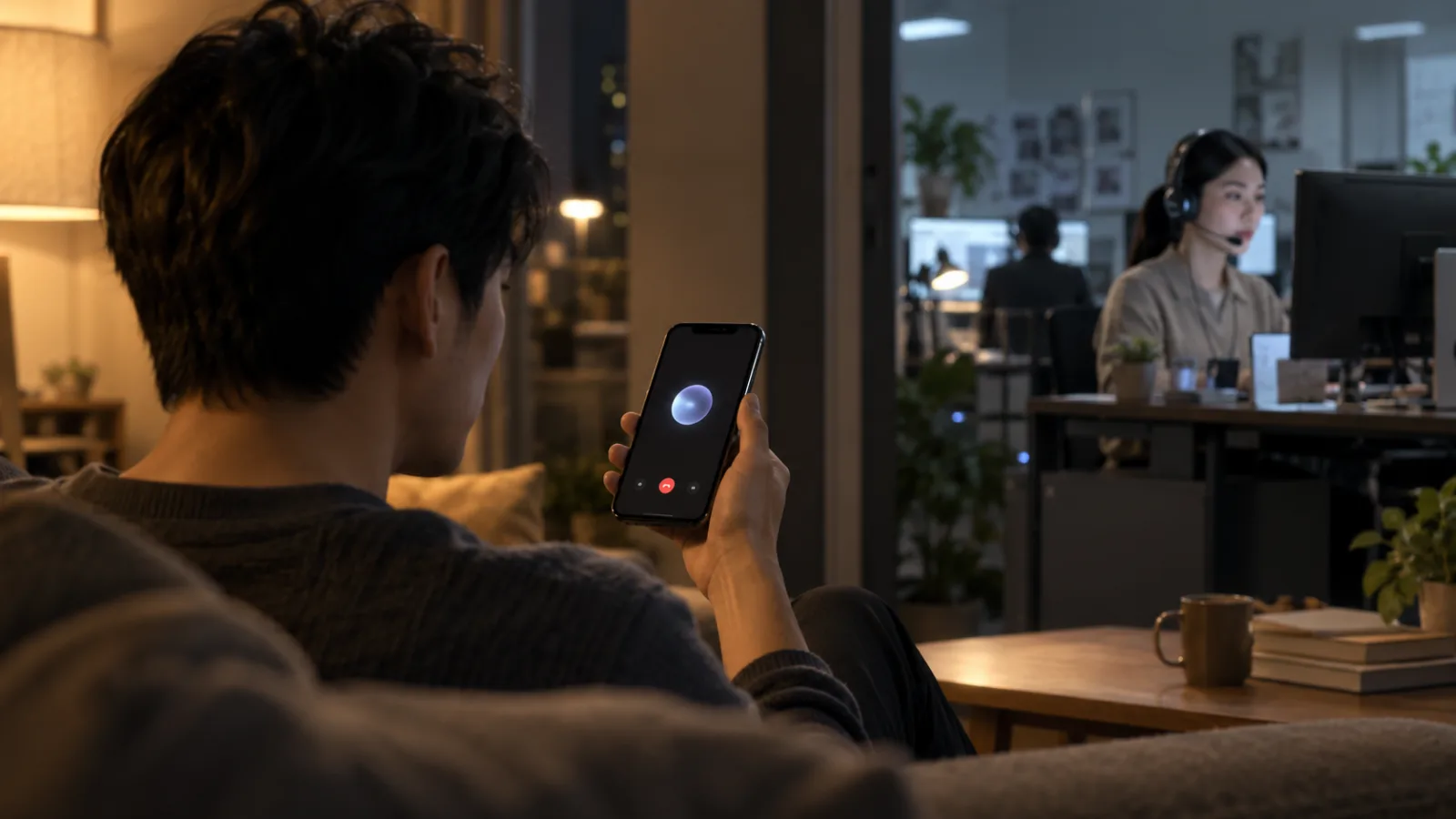
Your phone is in your pocket.
Inside, there’s already AI.
Your watch has AI.
Your earbuds are starting to have AI.
Even glasses are being fitted with AI.
Logically,
there shouldn’t be any need to carry another device on you.
But Meta recently made one anyway:
An AI you can hang on your keychain.
It’s called Muse Charm.
It’s Not a Phone or a Smartwatch
Meta unveiled Muse Charm for the first time at Connect 2026 on September 23.
It’s a small, portable device
you can carry in your pocket,
or hang directly on your keychain.
It has a small screen on the front,
which displays Muse’s virtual character.
Next to it is a fingerprint sensor.
The operation is purposely simple:
Tap the sensor,
and you can start talking with Muse.
No need to take out your phone.
No unlocking required.
No searching for an app.
No need to tap a microphone button again.
During the announcement, Mark Zuckerberg described it as:
If you’re not wearing Meta’s AI glasses,
this will be one of the fastest ways to access Muse.
What Meta Really Wants to Remove May Just Be “Extra Steps”
At first glance, this device easily raises the question:
My phone is right here, so why do I need this?
But if you break down the user process,
Meta isn’t trying to solve a problem of lacking phone capability.
Instead, it’s:
Taking out the phone.
Looking at the screen.
Unlocking it.
Finding the app.
Opening the AI.
Then starting to talk.
There are quite a few small steps in between.
Muse Charm’s goal is to reduce this to:
Pick up → Tap once → Talk.
Meta positions Charm as a device dedicated specifically to “talk and interact with your Muse,” and says it will reveal more details later.
It might only save a few seconds.
But tech companies care deeply about those seconds.
If a tool always requires you to:
Grab your phone first.
Open an app first.
Find the feature first.
A lot of people end up not using it continually.
If it becomes something you hang on your bag or keys,
your usage habits could change completely.
What’s More Interesting Is That It’s Designed Not to Look Like a “Work Device”
Muse Charm isn’t a cold, black box.
It has a small screen,
which features an animated Muse character inside.
TechCrunch and other media compared it directly to a Tamagotchi, an electronic pet.
This design is worth noting.
Because traditionally, we think of AI assistants as:
A chat box.
A search box.
A microphone button.
But Meta is now trying to turn it into a:
“Character that stays with you, and you can call anytime.”
The difference is not just physical.
It changes your relationship with AI.
Before, it was:
“I need AI, so I open ChatGPT, Gemini, or Muse.”
In the future, it might slowly become:
“It’s already right beside me.”
How Small Is It?
Meta hasn’t fully revealed the final hardware specs yet.
The company only confirms:
Charm is a Muse-dedicated device you can put in your pocket,
including real-time voice features,
and it’s still undergoing final adjustments.
External reports based on demos and insider info say
the prototype is about the size of an AirPods charging case,
with about a 2-inch touchscreen,
and may include 5G connectivity.
Important to clarify:
The 2-inch screen, 5G, and other specific details mainly come from media reports—not officially confirmed final specs from Meta.
Zuckerberg also stated the team is still deciding on internal component configuration and final external design.
So what we’ve seen from Muse Charm so far is more like:
A publicly displayed prototype readying for commercialization.
Not a finished product with fully locked-in specs.
We Don’t Even Know the Price Yet
This is another reason not to speculate too much.
Meta has said it hopes to start shipping around the holiday shopping season in December.
But so far,
official pricing has not been announced.
Nor have they revealed full details on:
Battery life.
Final weight.
Complete hardware specs.
Initial countries for release.
If you see anyone listing full pricing or final specs,
you need to distinguish what’s official
and what’s media speculation.
The Real Fascination Isn’t the Hardware—it’s Muse Becoming “Everywhere”
Muse launched on September 8,
and it was already more than a regular chatbot.
It can handle emails, travel, shopping, and other tasks for users,
even continuing to work after closing the app.
SasaDaily has previously covered this comprehensively:
Now Meta also announced Muse will be built into AI glasses
and into Muse Charm.
In other words,
Meta’s direction is becoming clear:
Muse doesn’t want to live inside one app.
It wants to follow you across different devices.
At your computer,
you can call it.
Wearing glasses,
you can call it.
No glasses?
There’s still a Charm on your keys or in your pocket you can call.
Meta even described Connect 2026’s theme as:
Building a family of devices letting users access their personal AI agent from multiple places.
But “Always Available AI” Also Brings Another Challenge
If AI only lives as an app on your phone,
you at least know exactly:
When you open it.
When you’re using it.
When you close it.
But if AI starts appearing as:
Glasses.
Keychain.
Earbuds.
Portable gadgets.
The boundary between it and your life becomes increasingly blurred.
That doesn’t mean these devices are inherently problematic.
It means users need greater clarity on:
When microphones are active?
When cameras might provide visual info?
What data is sent to AI?
What can AI do on my behalf?
Which actions require my approval?
This is why Muse is worth watching for more than just “whether it answers questions.”
SasaDaily previously broke down the authorization issues around Muse handling sensitive actions like sending emails or making payments:
Recently, another everyday concern arose:
When Muse makes calls for you,
Meta is even testing using human contractors to take over some calls.
Why Does Meta Let Human Contractors Take Over Some AI Calls Even When You Ask AI to Call?
From an app,
to doing things for you,
to making calls,
and now becoming a device you carry on you.
Muse’s evolution neatly follows a common path for AI development.
The Next AI Battle Might Not Be “Which App Is Best”
Over the past two years,
AI companies competed on:
Whose model is smarter.
Who responds fastest.
Who handles longer documents.
Who generates nicer images.
But if every model becomes good enough,
the next question is likely:
Who makes calling AI easiest?
OpenAI can put ChatGPT into more work environments.
Google can leverage Android, Gmail, Chrome, and other services.
Apple controls iPhone, Watch, AirPods.
Meta is betting on:
Glasses.
Social platforms.
And now this specialized AI portable device.
At this point, competition isn’t just about how strong the AI is.
It’s about:
How close AI is to you.
The Real Question Isn’t Whether You Need an AI Keychain
Whether Muse Charm succeeds in the end
is still unknown.
The AI hardware market has seen many failed attempts before.
If a new device only ports a phone app into a smaller box,
users might not want to carry something extra.
But what makes Muse Charm worth watching
isn’t whether it will succeed.
It’s that Meta is testing a new usage habit:
AI no longer needs you to open it.
It can always be with you.
If that direction takes hold,
our understanding of AI may shift gradually from:
“Which AI did I use today?”
to:
“Which AI was with me all day?”
Understand AI every day in the simplest way.
SasaDaily.com