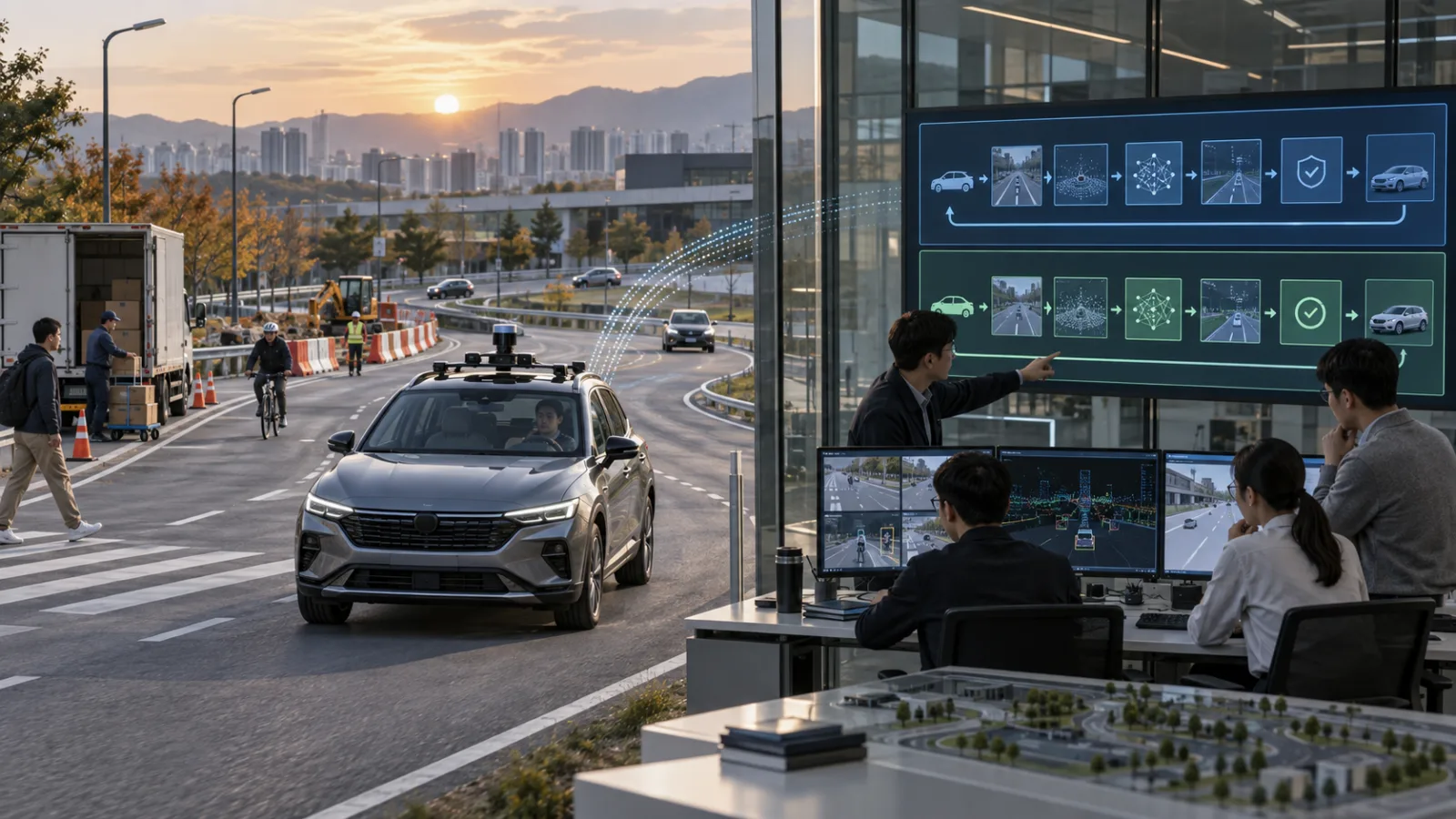
The most visible aspect of the autonomous driving industry is usually the Demo.
A car:
Turns by itself.
Changes lanes on its own.
Navigates intersections independently.
It looks like AI is about to remove the driver entirely.
But Hyundai's newly announced roadmap today reminds us of something else.
Mass production is far harder than a demo.
Hyundai Motor Group is now adopting:
a dual-track strategy.
One track:
Use Nvidia technology first.
The other:
Continue developing its own Atria AI system.
The timeline for the in-house system’s large-scale deployment is:
pushed back to 2029.
Hyundai’s self-developed autonomous driving delayed to late 2029
Reuters reported today:
Hyundai Motor Group had originally hoped to:
launch its own advanced driver assistance system by around the end of 2027.
Now, the new schedule is set for:
the second half of 2029.
That's about a two-year delay.
However, Hyundai is not:
doing nothing during this period.
On the contrary,
it plans to leverage Nvidia’s technology
to bring some capabilities into production vehicles ahead of time.
Nvidia-powered vehicles slated for 2028
Hyundai officially released its roadmap today, showing:
Production cars equipped with Nvidia solutions at:
Level 2+
target production:
early 2028.
Followed by:
Level 2++
production planned for:
late 2028.
Later:
Hyundai’s self-developed:
Atria AI Level 2++
is targeted for:
the second half of 2029.
So the real change today isn’t that Hyundai is abandoning its own autonomous driving technology,
but rather:
using Nvidia to accelerate production first, then using the production fleet to improve its own AI.
An intriguing strategic approach
Common thinking might ask:
If the end goal is your own AI, why not just wait?
The challenge is:
One of the most valuable assets for autonomous driving isn’t just in the lab.
It lies in the:
real-world roads.
Only when cars are actually on the road do they encounter:
construction zones,
parked vehicles,
rainy weather,
faded lane markings,
suddenly cutting-in motorcycles,
irregular intersections,
pedestrians,
bicycles—
these are the edge cases the AI models truly need to learn from.
Hyundai aims to build a Data Flywheel
Hyundai explicitly places the:
Data Flywheel
at the center of its autonomous driving strategy.
The process is easy to understand:
Cars hit the road.
↓
Collect road data.
↓
Identify situations where AI underperforms.
↓
Retrain the model.
↓
Simulate.
↓
Validate.
↓
Deploy updates.
↓
Cars are back on the road.
And the cycle repeats.
This is:
Data → Learning → Validation → Deployment → More Data.
What matters most is not "lots of data" but how fast it can be turned into updated AI
Hyundai stressed something vital.
The future of autonomous driving competition isn’t just about:
how much data you can collect,
but rather:
how quickly you can turn data into learning, verification, and product improvements.
This is very similar to today’s large model AI competitions.
Having lots of data:
is not enough.
Having a strong model:
is also not enough.
The real challenge is:
the entire:
feedback loop
and whether it can run fast.
Hyundai’s major advantage: a huge fleet of vehicles
Hyundai Motor and Kia together sell:
over 7 million vehicles globally each year,
covering about
190 countries and regions.
For autonomous driving, this means something very important.
If future production cars use consistent sensor architectures
and the proper usage and data conditions are obtained,
the fleet may become:
a massive
Data Collection Network.
Hyundai doesn't have to start from a few hundred test vehicles like startups.
It is, in itself, a global mass-production automaker.
However, specialized data collection vehicles are still limited
Hyundai states:
The group currently operates about
40 dedicated Data Collection Vehicles
continuously gathering road data.
So don’t mistake
7 million vehicles per year
for
7 million cars already training Atria AI.
They’re not.
7 million represents the scale of a
future expandable fleet,
not
cars currently all serving as autonomous training vehicles.
Nvidia Hyperion 10’s role goes beyond "just a chip"
Hyundai is standardizing the sensing and development architecture used by:
Hyundai,
Kia,
42dot,
and Motional
around Nvidia DRIVE Hyperion 10.
This is critical.
Because if sensor configurations differ drastically between vehicles,
the collected data’s
format,
viewpoint,
and quality
could vary greatly,
making it difficult to collectively use for
training,
validation,
and simulation.
A unified architecture mainly makes the data
easier to integrate into the same learning system.
Hyundai and Nvidia cooperation is not a full tech outsourcing
Hyundai executives stressed today that their collaboration with Nvidia
does not mean handing over the company’s fate completely.
Hyundai’s approach is:
co-design first,
use Nvidia’s platform to help achieve 2028 production,
and simultaneously use the data generated
to train and improve
its own
Atria AI.
They want to borrow speed,
not permanently surrender their technological sovereignty.
This is "buying ready-made capabilities" and "building your own" simultaneously
Companies adopting AI
often face the same dilemma.
Do everything in-house:
high control,
but slow.
Buy from others:
fast,
but prone to vendor dependency.
Hyundai chooses:
short-term use of mature external tech to save time,
while
building its own core tech long-term.
This approach is more realistic than an all-or-nothing “build vs buy” choice.
The trade-off: Nvidia’s role in the car deepens
Nvidia isn’t just a GPU supplier to data centers anymore.
It’s moving into:
automotive,
robotics,
factories—
physical AI territories.
Hyundai and Nvidia’s partnership now spans beyond
ADAS, including
AI data centers
and Boston Dynamics’ humanoid robots under Hyundai.
So Nvidia aims to provide not just a chip, but
a comprehensive computing and development platform for AI in the physical world.
Level 2+ / 2++ are not full self-driving
It’s critical to clarify:
According to Reuters descriptions of Hyundai’s new plan:
Level 2+ refers to more advanced highway driver assistance,
Level 2++ to more complex urban driving capabilities,
potentially similar to Tesla FSD-type assistance.
But importantly:
Both still require driver supervision.
So don’t interpret the 2028 Level 2++ launch as Hyundai introducing fully driverless cars.
It’s not.
Hyundai’s released Atria AI video doesn’t guarantee production readiness
Hyundai has shown footage of their Atria AI testbed operating Level 2++ in complex urban traffic, including one-take executive ride-alongs and edge-case handling.
This demonstrates the system can do many things,
but test footage
and handing over to everyday consumers
are worlds apart.
Reliability, extreme conditions, hardware, regulations, validation, liability, and production all involve many layers.
Hyundai’s two-year delay might indicate industry gaining pragmatism
In autonomous driving over the past decade, one thing commonly happens:
timelines get pushed back.
Demos can easily showcase:
90% of the capability,
but the real challenge is the remaining
10%
or even the last
1%
Driving normally is easy; the hard part is the rare situations you only encounter a few times a year but could cause serious consequences if mishandled.
This is why we can’t judge autonomous driving just by average success rates.
Edge cases are the toughest
Examples include:
A truck ahead dropping items,
police making hand signals,
temporary road closures,
construction lane markings conflicting with the original lane,
heavy rain,
strong glare,
an approaching ambulance,
a pedestrian suddenly turning around.
Though rare,
they are unavoidable on public roads.
Thus Hyundai’s Data Flywheel isn’t just about:
collecting more terabytes of data daily,
but more importantly:
quickly identifying situations where the model doesn’t realize it’s failing.
Hyundai continues work on Vision-Language-Action (VLA)
42dot also announced today they are developing:
Vision-Language-Action.
Simply put, this approach has AI not just:
see images and directly output steering controls,
but combine:
visual understanding,
language-based reasoning,
and actionable decisions.
For example, AI recognizing road construction ahead
and understanding
"the original lane is temporarily invalid,"
then deciding the next action.
This research path aims to improve handling of edge cases.
But VLA is still under study and validation
Hyundai states that model validation is ongoing,
and on-road testing will gradually start soon.
Thus, it’s premature to say:
"Hyundai has formally mass-produced VLA autonomous driving."
That’s not the case yet.
Hyundai plans Level 4 real-world pilot by year-end
Hyundai also plans to,
before year-end,
partner with the Korean government
to conduct Level 4 real-world pilot testing in Gwangju.
One goal is to gather a larger volume of validation data.
This again points to the same truth:
progress in autonomous driving is not solely driven by
larger models,
but by:
real-world deployment → problem discovery → retraining → further validation.
Waymo’s operational stage is a different maturity level
Yesterday, SasaDaily reported:
Lyft and Waymo have launched real driverless cars for ride-hailing in Nashville.
This means Waymo’s challenges include not only
AI driving capability,
but also
vehicle cleaning, charging, maintenance, and fleet dispatch.
Hyundai’s current focus is at an earlier stage:
how to scale advanced driver AI into mass-produced cars.
These illustrate different maturity stages in autonomous mobility.
Uber tackles another real-world challenge
Though Uber promotes robotaxis,
it also cooperates with driver groups to demand stricter regulations on autonomous platforms.
So beyond technology, issues like operations,
labor,
insurance,
regulation,
liability,
and public acceptance
remain critical.
Building autonomous driving as an industry requires more than just AI.
Amazon Prime Air tells the same story
Amazon showed drone delivery back in 2013,
but only prepares large-scale expansion by 2026.
The delay isn’t because drones couldn’t fly,
but due to challenges in safety, obstacles, noise, weather, regulations, community acceptance, and large-scale operations.
All Physical AI applications eventually face this reality:
Demo success is just the beginning.
The real Physical AI barrier may not be a single AI model
If AI models become easier to obtain,
the hard-to-copy assets for companies like Hyundai, Tesla, and Waymo will be:
fleet,
data,
sensors,
simulation,
validation,
engineering,
mass production,
maintenance,
and software updates.
Combined, these form a complete
autonomy system.
Hyundai aims to surpass competitors in driving data volume by 2033
Reuters reports Hyundai’s goal that once mass production cars extensively collect data,
the group hopes to
surpass competitors in accumulated driving data by 2033.
This is Hyundai’s target,
not a guaranteed outcome,
but it clearly reflects the strategy of
using automotive manufacturing scale to drive AI data scale.
Whether traditional automakers can catch AI firms depends on this
Hyundai’s strengths include:
car manufacturing capability,
supply chain,
factories,
dealerships,
global sales,
and millions of customers.
AI-native companies may lead in:
software,
data loops,
model training,
and iteration speed.
The real competition is:
whether traditional automakers can
transform their
manufacturing advantages
into
AI learning advantages.
This is exactly the problem the Data Flywheel aims to solve.
If they fail, millions of cars are just hardware
Seven million cars sounds impressive,
but if data cannot be:
collected back reliably,
normalized,
labeled,
trained quickly,
validated rapidly,
or updates deployed fast,
then
7 million cars
do not automatically translate into
7 million times AI advantage.
The key is not fleet size, but
Fleet → Data → Model → Vehicle
cycle speed and effectiveness.
Nvidia aims to sell the entire ecosystem in this cycle
Hyperion,
AI compute,
training infrastructure,
simulation,
vehicle platforms,
and robotics
make Nvidia increasingly a
Physical AI
infrastructure provider.
In the past,
key automotive suppliers were
engines,
transmissions,
brakes.
In the future, another layer may be
AI computing stack.
So Hyundai’s delay isn’t a loss of vision
It rather acknowledges that mass-deployable autonomous driving demands longer
learning,
validation,
and production
cycles.
This doesn’t guarantee full success by 2029,
nor that Nvidia’s approach is better,
but it offers the market a clearer view on how Hyundai balances
short-term speed to market
and
long-term technical autonomy.
This is a key lesson for enterprises adopting AI
Not all core capabilities need to be built in-house from day one.
Some areas can use mature external platforms initially,
end users can enter
real usage,
collect real problems,
and then decide
which capabilities to develop long-term internally.
The prerequisite is:
not handing over
all the
data,
know-how,
and decision layers too.
Otherwise, short-term speed gains
may lead to losing core technology sovereignty in the long run.
The real takeaway isn’t Hyundai’s two-year delay
but rather:
the autonomous driving industry moat is shifting from "who shows the most impressive demo first" to "who can fastest build a real-world data flywheel."
Cars on the road.
Problems encountered.
AI learns.
Safety verified.
Updates deployed.
Back on the road.
The faster and more error-free this cycle runs,
the more gap can form between competitors.
The next time a company says:
"Our AI car can drive itself,"
the question to ask isn’t
"How far can it drive?"
but:
"After encountering an unseen situation, how long before the whole fleet has learned from it?"
That might be the true competitive edge in the next phase of autonomous driving.
Today, grow alongside AI a little more.
Learn an AI skill daily.
Save a little time each day.
Enhance your abilities bit by bit.
SasaDaily, growing with you.
Recommended Reading
Why Does Lyft Rely on Former Drivers to Support Waymo Despite Having Driver-Based Services?
Why Is Uber Teaming Up with Driver Groups to Restrict Waymo While Promoting Robotaxis?
Amazon Prime Air Drones Launched in 2013, So Why Expand to Nearly 500 US Cities Only in 2026?