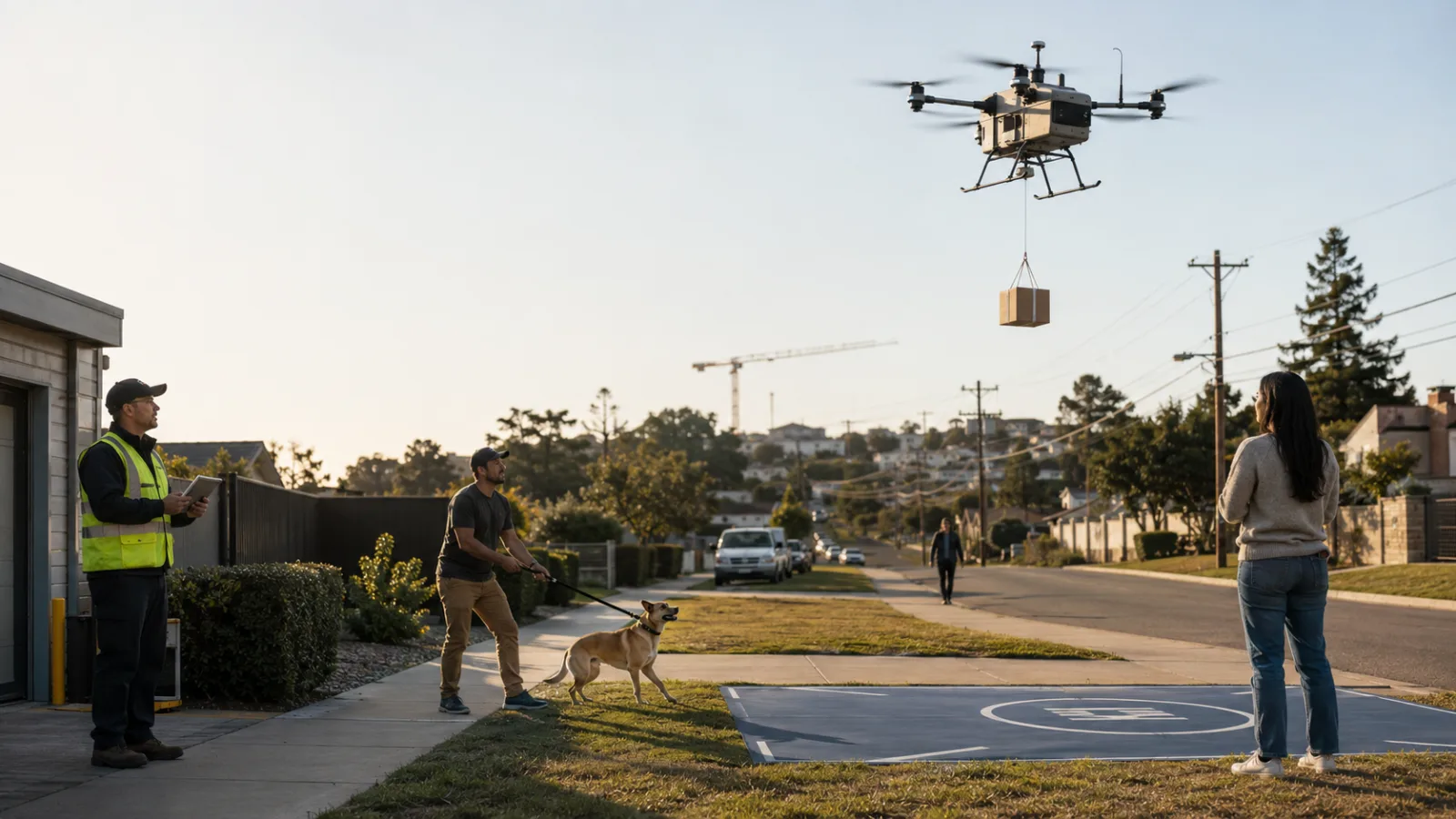
In 2013, Jeff Bezos showed the world a scene that looked like something out of a sci-fi movie at the time:
Amazon packages,
No trucks needed.
No delivery drivers required.
Instead, drones would fly directly to your home.
Thirteen years later,
Amazon is finally preparing to bring Prime Air drone delivery to true large-scale commercial use.
Amazon recently announced that the Prime Air program plans to expand its service to nearly 500 US cities and towns by the end of 2026. Currently, the service operates from just 11 locations in the US, so this is a significant expansion—not just adding a few test cities.
The question is:
Why did a drone that could already fly in 2013 have to wait until 2026 to actually start flying into many communities?
The answer perfectly illustrates one of the biggest challenges of Physical AI.
The real challenge has never been "making the drone fly"
Getting a drone to:
take off,
fly along a set course,
deliver a package to a designated spot,
was already achievable over a decade ago.
The real challenge is:
having it fly out on its own every day, not knowing what it might encounter.
A branch that wasn’t there yesterday may have grown into the flight path today.
An empty spot yesterday may have a parked car today.
A dog might suddenly run into the yard.
A construction crane might appear nearby.
Other flying objects could be in the sky.
Even the spot where the package was supposed to be dropped might suddenly be occupied by a child.
This is the real world.
The crucial AI in Prime Air now is Detect-and-Avoid
Amazon’s latest MK30 drone doesn’t just follow GPS routes.
Prime Air’s Detect-and-Avoid system uses onboard cameras and sensors to constantly monitor the surroundings, allowing the drone to detect changes in airspace and on the ground and make real-time safety decisions.
Upon reaching the destination,
it must also confirm again that the delivery area is clear of:
people,
pets,
vehicles,
before dropping the package.
This is no longer simple “automation.”
It's a textbook example of:
Physical AI.
The AI must:
see the real world,
understand what’s happening,
make judgments,
and actually move a machine.
ChatGPT error and drone decision mistakes are completely different
Suppose ChatGPT answers a question incorrectly.
You might say:
"No, check again."
It might just waste a few minutes.
But if a drone flying autonomously over a residential area makes a wrong decision,
the consequences aren’t:
"Regenerate the answer."
It's a real machine with weight,
speed,
and mobility.
So the safety standards for Physical AI
are definitely more demanding than those for chatbots.
That’s why:
AI gets smart on screens much faster than AI can be safely deployed in the real world.
Like a child riding a bike in a parking lot, it doesn’t mean they can safely ride to school tomorrow
The simplest analogy is learning to ride a bike.
A child rides once in an empty parking lot.
No falls.
Turns smoothly.
You can happily say:
"They can ride a bike now."
But you wouldn’t let them:
cross a busy intersection alone tomorrow,
dodge cars,
judge slippery roads in the rain,
and safely ride to school.
Because:
being able to ride is a skill.
riding safely on real roads is deployment.
Amazon’s 2013 demonstration was closer to:
“This is possible.”
But in 2026, the real test is:
“Can this be reliably done every day in hundreds of cities?”
The gap is
13 years.
The real world has another factor AI can’t solve: people
Technical safety is only the first step.
Every time Amazon enters a new drone delivery community,
it must also navigate local governments, residents, and regulators.
Reuters reports that new locations require local approvals, with community discussions raising concerns about:
noise,
safety,
privacy,
and whether drones are suitable to fly daily over residential areas.
So even if engineers say:
"The technology is ready,"
residents might respond:
"But I don’t want to hear drones flying over my house every day."
This is a major difference between Physical AI and pure software.
ChatGPT can update its model
without asking your neighbors.
Drones flying into communities
must.
Accidents directly affect deployment speed
In 2025, two Amazon Prime Air delivery drones collided with a construction crane arm in Arizona, prompting investigations by the US NTSB and FAA.
This doesn’t mean:
drone delivery is inherently unsafe.
But it highlights an important fact:
The real world creates scenarios unanticipated in test environments.
So in MK30 safety tests, Amazon not only tests
"can it fly under normal conditions,"
but deliberately creates abnormal scenarios,
even having planes and helicopters approach the drone from various directions,
to test if Detect-and-Avoid responds correctly.
This is genuine deployment testing.
It’s not about:
"Has it succeeded once?"
But about:
"How does it handle unexpected events?"
So why is Amazon ready to expand massively now?
Because these 13 years haven’t been idle.
Amazon kept redesigning the drone body.
The new MK30:
flies farther,
operates in light rain,
delivers to smaller areas,
and keeps improving noise levels and autonomous obstacle avoidance.
Amazon also earned FAA Part 135 certification and enabled MK30 to fly beyond the operator’s line of sight using Detect-and-Avoid.
More importantly:
Prime Air is no longer just a lab demo.
Amazon states it has already completed hundreds of thousands of package deliveries by drone this year, covering millions of eligible products, with some arriving in as fast as 30 minutes.
This gives Amazon a reason to take the next step:
moving from a few test zones
to many cities.
But "nearly 500 cities" doesn’t mean drone logistics are fully successful yet
This is very important.
Amazon is announcing a:
plan to expand.
Not:
"Drones have replaced trucks."
Nor:
"All 500 cities have full access now."
Each new area still requires setting up sites,
local approvals, service area planning, community acceptance, and flight safety.
Amazon also said that Prime Air currently serves from 11 US sites, with more cities to follow.
So today’s real news is not:
"Amazon has delivered by drone all across the US."
But rather:
This 13-year effort is finally ready for its first true large-scale real-world test.
This is where the next wave of AI will be most fascinating
In the past two years,
we’ve mostly compared AI based on:
who answers questions better?
who codes faster?
whose models score higher?
But with Physical AI,
the criteria completely change.
Future comparisons may focus on:
who can get machines to operate safely in the real world?
who can handle the most unexpected situations?
who passes regulations?
who gains community acceptance?
who reduces costs enough for daily use?
Because truly world-changing AI isn’t just about:
what works in a demo.
It’s about:
working on Monday, working in rain on Tuesday, avoiding construction on Wednesday, and still reliably operating millions of times a year.
Thirteen years have taught us: there’s a huge world between demo and deployment
In 2013,
Amazon showed us:
packages flying through the sky.
In 2026,
it must prove:
this can become ordinary people’s everyday life.
These two look like they are just one step apart.
But actually,
between them lie:
engineering,
AI,
safety,
regulation,
cost,
community acceptance,
and countless real-world unpredictable events.
So when you see the next amazing AI demo,
maybe ask one more question:
Is it "can do," or is it "can do safely every day"?
Those two statements are very different.
Today, grow a little with AI.
Learn one AI skill a day.
Save a little time every day.
Improve a little each day.
SasaDaily, growing with you.