If today you want to add a robotic arm in a factory,
it’s usually not a matter of:
“Buy it, plug it in, and it starts working.”
The real hassle comes in the long list of tasks afterward.
How should the workstation be arranged?
Where should the robot be placed?
Where do the parts come from?
How should the arm move?
When should it grab?
Where to place the item after grabbing?
And what if it gets stuck?
These tasks have always been heavily dependent on engineers.
But Vention now aims to do something similar to how we use ChatGPT:
You first tell AI what you want the machine to do.
From there,
AI starts assisting you with the rest.
Vention Calls This AI System MachineAgent
Vention recently announced a new Agentic AI system:
MachineAgent.
It is scheduled to be showcased at the IMTS manufacturing expo from September 14 to 19, 2026.
This AI won’t just sit beside engineers as a chat companion.
Vention intends to integrate it throughout the entire automation process:
Design.
Programming.
Deployment.
Monitoring.
Troubleshooting.
The truly interesting part is that:
AI is no longer just operating machines.
It is starting to assist those who design how machines work.
Previously, the First Step Was Engineers Designing Workstations Themselves
Suppose you run a factory.
You want a robotic arm to:
Pick parts from a conveyor belt.
Turn around.
Place them into another fixture.
That sounds like just three simple actions.
But in actual design,
engineers must also consider:
Where should the robotic arm be?
Is its reach sufficient?
What is the angle of the conveyor belt?
What is the fixture height?
Will the arm collide with anything when moving?
Where should safety equipment be placed?
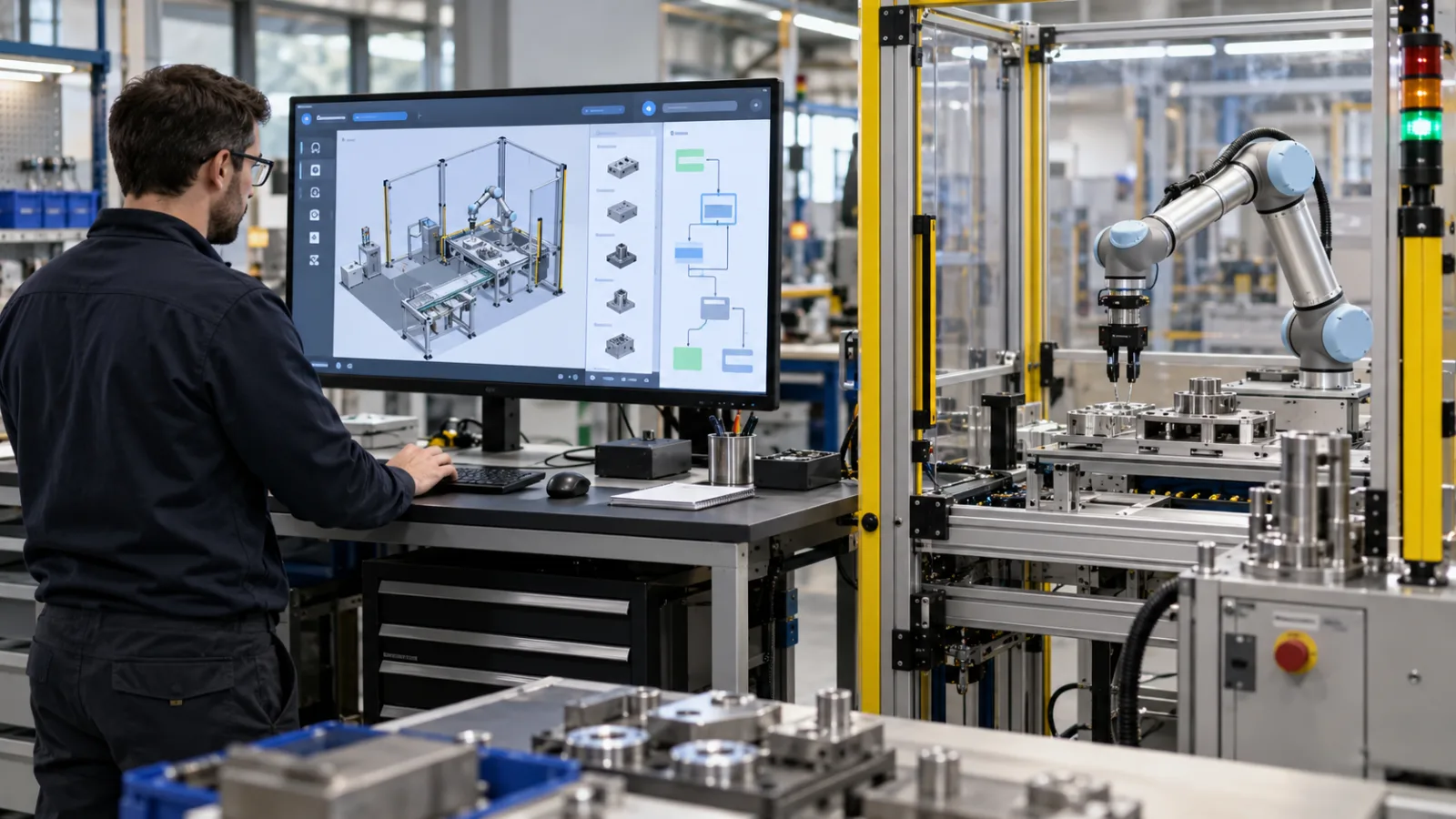
Previously, all these details had to be carefully arranged in CAD or automation design software.
Now, Vention wants you to first describe your needs in plain language.
For example:
“I want a robotic arm to pick parts from the conveyor and place them in the adjacent workstation.”
MachineAgent can then create a preliminary automated cell layout based on this description.
But AI-Generated Layouts Are Starting Points, Not Final Orders
This is crucial.
Vention explicitly states:
The AI-generated layout should be considered a
Starting Point.
It is not the final answer.
Users must still verify it with an Automated Design Checker.
Designs involving safety must be approved by qualified engineers
before proceeding to the next step.
So it’s not:
“You don’t need engineering knowledge to build a factory with a single sentence.”
Rather, it’s like:
Previously, engineers started with a blank canvas.
Now AI helps create the first draft.
Humans then review,
revise,
and approve.
Next, Programming Is Also Written Using Prompts
Once the workstation layout is done,
the machine still won’t move on its own.
The robotic arm needs instructions on:
When to start.
Which motor to activate.
Where to move the arm.
When to open the gripper.
What to do next after receiving a sensor signal.
This is industrial programming.
Vention’s MachineLogic Copilot can now directly access the machine’s configuration and robot scene context.
Users describe what the application should do,
and AI helps generate new programs, or modify and debug existing ones.
This is similar to how we use coding agents today.
But unlike AI-generated code that usually runs in websites or apps,
this time the program controls
a real robotic arm.
IMTS Visitors Can Even Try This Onsite Today
At Vention’s demo,
visitors can use MachineLogic Copilot
to write programs for a real UR3 robot workstation.
The entire presentation includes:
AI-generated cell design,
industrial programming,
digital twin simulation,
physical deployment,
equipment fleet analysis,
and troubleshooting.
So the showcase isn’t just about:
“AI answering questions from a robot.”
It demonstrates the whole journey:
Describe requirements → design → program → simulate → operate real machines.
The Most Intriguing Part: AI Stays Even After Machines Break Down
The real challenge in factories
is often not when equipment first runs.
It’s when:
After a month, processes start slowing down.
Some machines frequently stop working.
Sensors occasionally fail.
Cycle times lengthen.
Where exactly is the problem?
Engineers typically have to:
Review logs.
Check error records.
Compare equipment performance data.
Inspect different machines.
Gradually narrow down the source of issues.
MachineAgent wants to integrate this troubleshooting phase as well.
Vention says users can let AI analyze performance data and logs from multiple deployed devices,
identify abnormal systems,
diagnose operational issues,
and provide corrective recommendations.
In other words,
this AI does not only help you:
Build the machines.
It also sticks with you to:
Maintain and nurture the machines.
This Complements Yesterday’s Story About Skild
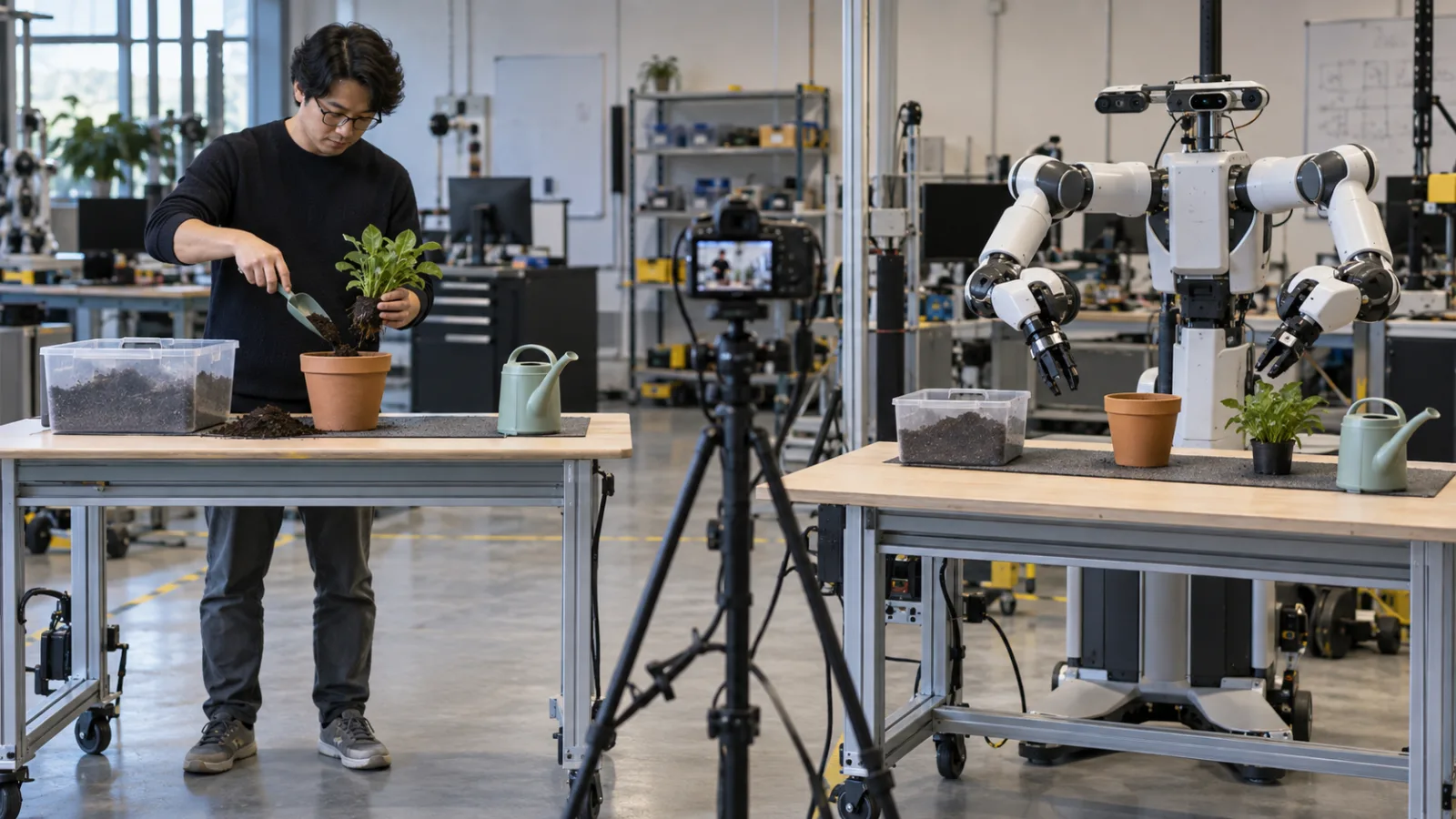
Yesterday, we explored Skild S1, which tackles another problem:
How can machines learn new tasks faster?
Previously, when machines switched jobs,
they needed to collect tens of hours of data.
Skild aims to change that by:
Humans demonstrating the task once,
and the machine understanding the new task from video.
Today, Vention addresses the other side:
How can people build entire automation systems faster?
Before:
Engineers designed,
wrote code,
and debugged on their own.
Now:
Engineers describe goals.
AI generates design and programs.
Humans then verify, adjust, and approve.
Put these together and you see a clear trend:
Machines are getting smarter at learning.
At the same time,
those designing machines are starting to have AI assistants.
Vention Also Introduces a Layer Called Physical AI
MachineAgent is an Agentic AI focused on helping:
People.
But Vention is also working on another aspect:
Physical AI.
For example, its Rapid Operator AI enables robots to see parts inside boxes at different orientations and positions.
The system first identifies objects,
estimates poses,
selects grasping methods,
then plans collision-free paths around obstacles.
If it fails the first grab,
it tries again.
Another demo only requires telling the robot:
Where to start,
where to finish,
and how to go around obstacles.
The system then calculates collision-free paths without engineers programming every intermediate waypoint.
This is what Vention calls:
AI-Defined Automation.
From the top layer,
AI assists humans in designing and managing.
At the bottom layer,
AI helps machines perceive, reason, and act.
Does This Mean Engineers Are Becoming Obsolete?
Not at all.
In fact, quite the opposite.
Vention’s product documentation clearly states that designs related to safety must be approved by qualified engineers.
AI-generated outputs can still have bugs or be incomplete.
So far,
The IMTS demos mainly prove these capabilities can be showcased, integrated, and operated.
They don’t yet prove:
Every factory can now hand over the entire engineering workflow directly to MachineAgent.
External industry media also remind that public information does not yet demonstrate widespread real-world adoption of these capabilities at customer sites.
The most reasonable understanding now is not:
AI replacing engineers.
But rather:
Engineers no longer have to do everything from zero themselves.
This Is Very Similar to What Happened With Coding Agents
A few years ago,
programmers wrote every line of code themselves daily.
Now with tools like Codex, Claude Code, Qodo, and other coding agents,
programmers haven’t ended up with only one task:
“Click generate.”
Instead, they spend more time on:
Requirement gathering.
Architecting.
Reviewing.
Testing.
Managing permissions,
Assessing risks,
and sign-offs.
Industrial automation is likely headed in the same direction.
Engineers previously spent extensive time:
Designing parts,
setting layouts,
writing repetitive logic,
examining logs,
and debugging.
In the future, some of these steps
may first be handled by AI.
The truly important human tasks become:
Is this design reasonable?
Is it safe?
Does it really fit the site conditions?
If AI makes a wrong call,
who stops the process?
The Real Change Is Not the Engineer Role Itself
But what engineers do every day.
Previously, an 8-hour day might look like:
3 hours designing.
2 hours programming.
2 hours debugging.
1 hour decision making.
In the future, maybe it becomes:
AI designs first.
AI writes code first.
AI finds problems first.
Humans spend more time on:
Judgment.
Verification.
Handling exceptions.
Confirming with on-site personnel.
Deciding whether the machine truly runs.
This trend closely mirrors recent changes we’ve seen in AI-related jobs.
AI doesn’t take entire roles away immediately.
It first automates the
most standardizable tasks.
The Real Story Here Is Not “Controlling Robots with One Sentence”
That spectacle is certainly eye-catching.
But what really matters is:
Industrial automation has always been a highly specialized,
engineering-intensive field.
Now even this realm
is undergoing:
Natural language → AI Agent → real machines.
Yesterday,
workers began “showing machines the task once.”
Today,
engineers start “telling AI once.”
Both directions are converging.
In future factories,
the most valuable people may not be those who personally do every step.
But those who know best:
What the machine should really do, which tasks can be delegated to AI, and which require human approval.
If this is your work,
which repetitive design, coding, or checking tasks would you most want to hand over to AI first?
Today, level up with AI a little.
Learn one AI skill every day.
Save a little time every day.
Improve a little bit every day.
SasaDaily, growing alongside you.
Recommended Reading
Why Skild Can Teach Robots New Tasks by Showing a Video Instead of Hours of Data Collection
Why Harmoni Attaches Just a Tablet Next to Old Machines Instead of Using Humanoid Robots