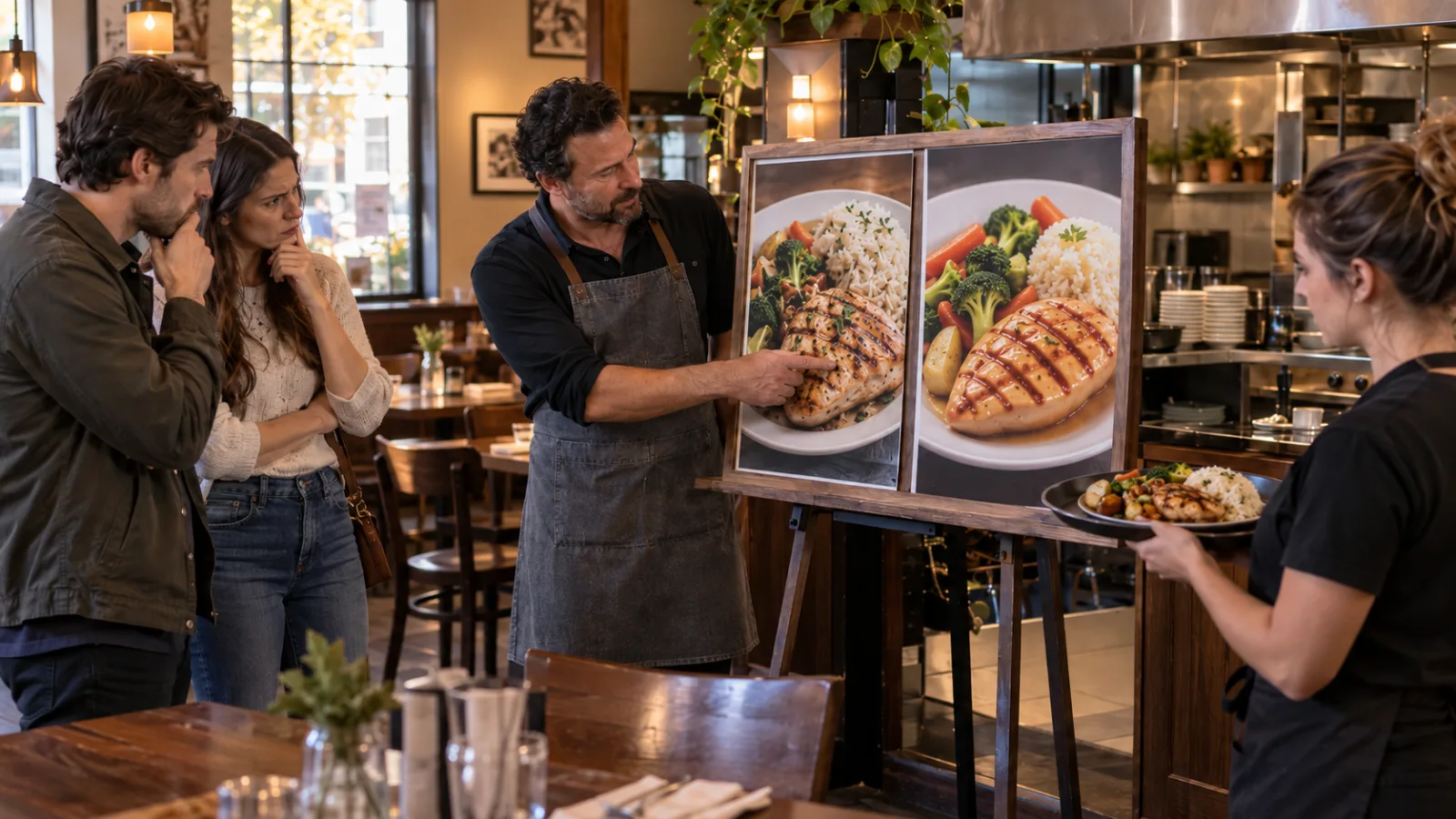
If you walk up to a restaurant and see a photo of a steak on the menu,
the meat looks perfectly cooked,
the sauce glistens just right,
and each side dish is arranged flawlessly like an ad.
Normally, you'd probably be more tempted to order it.
But nowadays, some consumers’ first reaction is:
Is this even real food?
Recently, more and more restaurants in the U.S. have started using AI-generated food images in menus, posters, and social media ads.
The intention was to save money.
But an interesting problem emerged:
Why do AI-made food photos, which can look more attractive, sometimes actually reduce appetite?
People React to AI Menus by Taking Photos and Criticizing Instead of Ordering
On September 6, 2026, The Guardian reported several cases occurring across the U.S.
In Denver, nurse Jill Sennett saw an AI-generated menu at a Jamaican BBQ pop-up during her lunch break.
The meat in the photo didn’t look appetizing at all.
Instead, it reminded her of leather, with strange tiny bumps on the surface.
After sharing the photo with her roughly 26,000 followers on X, it went viral, sparking lots of discussion.
But what’s more notable is not the laughter at AI’s limitations,
but the restaurant’s own admission:
These images were indeed created using ChatGPT.
The reason is very practical:
Cost-saving.
The restaurant would usually pay a designer for photos, but to cut production costs for the pop-up event, they switched to AI-generated images.
This is very understandable for small restaurants.
Taking professional food photos involves prepping the dishes, arranging lighting, shooting, retouching, and designing layouts.
If the menu changes, all that work has to be redone.
Now, by simply entering a few words, you can get a seemingly complete food photo in minutes.
From a cost perspective, this makes sense.
But food images come with a unique challenge that differs from usual advertisements.
Food Photos Aren’t Just Decoration; They’re a Form of "Promise"
Imagine buying a smartphone.
Whether the background in an ad is AI-generated isn’t your main concern.
You care about the phone itself.
Restaurants, however, are different.
When you see a burger photo, you’re making a simple judgment:
Is the food on my plate going to look roughly like this?
So food photos don’t just make dishes look good,
they send a message on behalf of the restaurant:
“This is what we will actually serve you.”
When the image is purely AI-generated from scratch, that relationship changes.
The dish might never have actually existed.
The thickness of the chicken could be inaccurate.
The ingredients might be wrong.
The sauce placement could be unrealistic.
The portions might be off.
Even if the picture looks better,
the gap between the image and the real product grows.
The Biggest Issue with AI Is Not Errors but the “AI-Like” Feel
Current AI can create highly detailed food images.
But food is extremely sensitive to detail.
Meat shows fibers,
Bread displays irregular holes,
and vegetables’ edges aren’t perfectly uniform.
Sauce won’t be neatly and perfectly placed every single time.
TechCrunch analyzed this wave of AI menus recently and pointed out an interesting phenomenon:
When AI images undergo repeated editing, details tend to become smoother and more uniform.
Eventually, everything looks rounded, clean, and flawless,
but increasingly unlike real food.
This explains why some AI food photos might not show obvious errors at first glance,
yet you still feel there’s something off.
Something just feels unnatural.
Even Worse: When Customers Know the Photos Are AI, Their Perception Changes
This isn’t just subjective online complaints.
The Guardian cited Oxford University professor Charles Spence’s research showing a 2024 study that found:
When consumers are unaware that images are AI-generated, they may actually prefer AI photos.
But once they find out the images came from AI, their evaluations tend to drop.
This is crucial.
It means the problem isn’t only whether AI images look realistic,
but also:
“Do I trust this image?”
Food is a product that relies heavily on trust.
You can’t taste it before ordering.
The photos, menus, reviews, and restaurant atmosphere serve as your evidence before deciding.
So AI food photos may save money on photography,
but if done wrong,
they risk undermining that evidence’s credibility.
A San Francisco Café Had to Spend More to Fix an AI Image Backlash
Grind & Unwind in San Francisco once displayed AI-generated food photos on their signage.
It sparked strong local backlash.
Online critics described the bread surfaces as looking like reptile skin.
The storefront was even vandalized with graffiti.
The café eventually took down the AI-generated signs and spent about $700 to repair the wall.
This example is ironic.
One main reason for using AI was:
to save money.
But after hurting the brand image,
the business ended up paying a different kind of cost.
Of course, this doesn’t mean every restaurant using AI images faces backlash.
Another café interviewed by The Guardian, Bella Cafe, said they liked their AI images and hadn’t received customer complaints.
So it’s not as simple as saying:
“Restaurants should never use AI.”
The real question is:
Where and how should AI be applied?
AI Can Assist with Images but Shouldn’t Generate the “Actual Food” From Scratch
There’s a practical dividing line here.
Restaurants can prepare real dishes,
then photograph them with phones or cameras.
They can use AI to help with:
adjusting lighting,
cleaning up backgrounds,
removing distractions,
cropping photos,
creating social media layouts,
generating menu copy,
and producing promotional materials.
Here, AI is helping with:
“How to present the real thing better.”
Not:
“Inventing a dish that doesn’t actually exist.”
DoorDash’s current AI image features focus on improving existing dish photos, like tweaking lighting and colors or backgrounds; the platform prohibits restaurants from using misleading images that confuse customers.
Though both approaches are called “AI images,”
the difference is huge from a consumer perspective.
The Cheapest AI Solution Isn’t Always the Most Cost-Effective Business Choice
This issue extends beyond restaurants.
More small businesses will face similar choices:
Tasks that once required paying a person,
can now be completed by AI in minutes.
This is clearly progress.
But businesses must ask not only:
“Can AI do this?”
but also:
“Will letting AI handle this damage the core value?”
For restaurants,
the real value of food photos has never been just about looking good,
but about:
authenticity.
If AI helps you save hundreds of dollars on photography,
but makes customers question,
“What will the actual dish really look like?”
then it’s hard to say if you truly saved money.
The greatest value of AI may not be generating everything from scratch.
Often,
it’s best suited for:
making real things faster and better, rather than replacing the real things.
Today, improve together with AI.
Learn one AI skill every day.
Save a little time every day.
Enhance your abilities a bit each day.
SasaDaily, growing with you every step of the way.
Recommended Reading
AI Quick Q&A | 2026/07/15: Can AI-Generated Articles and Images Be Used Commercially?