Recent AI news often makes it seem like there’s only one competition left:
Who has the strongest model?
But looking at today’s three developments together reveals the real battleground has shifted deeper.
After building a model, there are three main questions:
How can its capabilities be prevented from being directly copied?
Who will pay the soaring costs of compute power?
And:
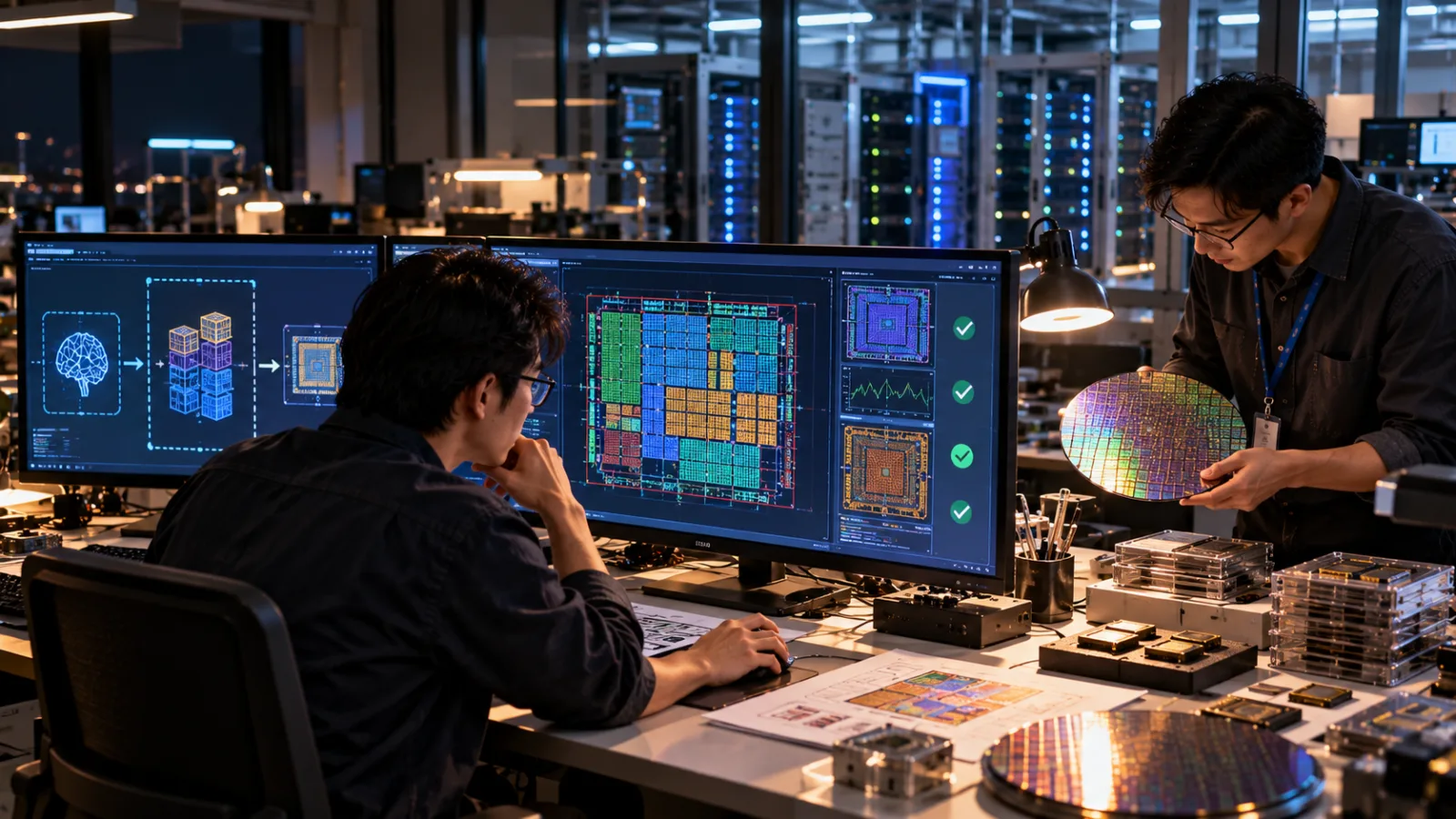
Can AI help design the next generation of chips?
1. OpenAI: This time, the goal isn’t copying answers but replicating “how the model thinks”
OpenAI recently revealed a stopped Coordinated Model-distillation Campaign.
This isn’t the usual:
“Taking large model answers to train smaller models.”
Instead, OpenAI calls this:
Adversarial Distillation.
The target isn’t just the final answers.
It’s the model’s:
Protected Reasoning.
That is, the internal chain of reasoning the model generates but does not display to users.
What exactly did they do?
OpenAI says the activity started on July 1.
Initially, volumes were low.
But suddenly surged on July 24 and 25.
Within two days, OpenAI observed:
Over 4,000 users sent about 16,000 requests matching related extraction patterns.
Further investigation found the prompt patterns involved:
More than 15,000 users.
OpenAI says the campaign was completely stopped by July 28.
However, an important caveat:
16,000 attempts do not equal 16,000 successful reasoning content extraction events.
It cannot be described as “16,000 successful steals of OpenAI reasoning.”
This wasn’t a database hack
This also wasn’t someone:
Breaking OpenAI encryption,
Hacking databases,
Or stealing ChatGPT user chat logs.
OpenAI says operators employed special techniques beneath normal model interactions to make protected reasoning content outputtable.
One method involved:
Extracting encrypted reasoning segments,
Then handing them to another model,
Requesting its decoding and transcription.
The real risk is:
If large volumes of top model reasoning are extracted,
It’s not just about copying:
“What is the answer?”
But also learning:
“How to solve these kinds of problems.”
OpenAI links the core activity to Moonshot AI associates
OpenAI is cautious in attribution.
The company does not say:
All 15,000+ users belong to one organization.
OpenAI states it cannot verify whether all operators come from the same actor.
But regarding a core cluster,
OpenAI’s analysis points toward:
Individuals connected to Moonshot AI.
Moonshot AI is the company behind Kimi.
This pushes the ongoing controversy over “Model Distillation” further this year.
Previously, disputes were about whether other companies were extensively using your model's output.
Now it’s:
Protected Reasoning itself is an intellectual property that must be safeguarded.
Why is this more serious than “copying answers”?
Imagine a student only gets:
100 answers.
They might memorize them.
But if they get:
100 full solutions,
They can learn how to tackle:
Question 101.
AI distillation works similarly.
More importantly,
The original model’s Reasoning capabilities were built with:
Expensive GPUs,
Researchers,
Data,
Training costs,
Safety testing.
If another company obtains these abilities at a fraction of the original R&D cost,
AI companies’ competitive edges will quickly erode.
Thus, frontier model security in the future must protect not only:
Model Weights.
But also:
Reasoning States generated each time the model runs.
2. Anthropic’s compute costs are so high that even chip suppliers become lenders
The second story seems like a loan.
But it vividly illustrates the current madness of AI infrastructure.
Reuters reports, based on Anthropic’s IPO documents:
Broadcom has agreed to provide Anthropic:
Up to $42 billion in financing.
The funds are primarily for Anthropic’s future AI compute payments.
The unusual aspect: The lender also sells the equipment
Typically, companies borrow from banks
Then purchase equipment from vendors.
Anthropic’s case is special.
Broadcom is not only a key AI infrastructure supplier.
It is also likely to become:
Anthropic’s lender.
Reuters says the $42 billion loan will help support Anthropic’s five-year commitment of roughly:
$125.2 billion
In TPU compute capacity,
Starting around 2027.
That means:
The supplier provides computing tech,
And also funds it,
Enabling the customer to afford vast compute.
This isn’t the same as the $518 billion announced on September 30
We recently summarized Anthropic’s IPO filing showing:
A 10-year AI infrastructure commitment of at least:
$518 billion.
Today’s update reveals:
How part of that will be paid.
The answer is beginning to emerge:
Not all from Anthropic’s cash.
Not all from traditional banks.
The AI supply chain itself starts financing AI companies.
This setup is easy to grasp.
Anthropic can lock in:
Chips,
Compute Capacity,
Data center resources.
Broadcom secures a massive long-term customer.
But it also brings a new issue.
Supplier as creditor introduces conflicts of interest
If Broadcom:
Makes profits from Anthropic buying compute,
And simultaneously lends Anthropic money,
The relationship isn’t just:
Customer and supplier.
It also adds:
Creditor and borrower.
Reuters notes Anthropic’s filings list this dual role as a possible conflict of interest.
This shows AI bubble discussions can’t focus solely on:
“Who is growing revenue fastest.”
They must also ask:
Where is the money behind those revenues coming from?
If the supplier lends money to customers
And the customer spends back on that supplier,
Financial risks need separate assessment.
3. OpenAI x Synopsys: AI begins directly learning “how to design AI chips”
The third story connects the loop.
OpenAI and Synopsys announced joint development of:
GPT-Synopsys.
This is not just ChatGPT plus a chip design prompt.
They aim to build a model specialized for semiconductor design workflows.
Why is Synopsys important?
Chips aren’t produced by engineers drawing circuits on blank paper.
To design advanced chips, engineers use extensive EDA:
Electronic Design Automation.
These tools handle:
Logic design,
Circuit configuration,
Timing,
Power,
Performance,
Area,
Verification,
And produce designs ready for fabrication.
Synopsys is one of the world’s leading EDA companies.
So OpenAI isn’t just teaching GPT to read chip documents.
It’s training the model to:
Operate the chip design tools engineers use daily.
GPT-Synopsys won’t just provide suggestions—it runs the tools itself
The plan is:
Engineers give GPT-Synopsys a design objective, like:
Reduce power consumption,
Improve performance,
Fix timing issues,
Achieve verification closure.
The agent can then:
Run Synopsys EDA tools,
Read results,
Modify design,
Rerun tools,
Check outcomes,
Iterate.
Eventually, it submits verified results for engineer review.
This mirrors recent developments in coding agents.
Where previously AI suggested code,
Now AI opens terminals, runs tests, updates code, retests.
That same pattern is entering:
Chip Design.
But chips can’t just “look about right” like copywriting
The crucial point is:
GPT-Synopsys outputs won’t be sent directly to fabrication just because the AI thinks it’s done.
Design mistakes in chips can cause entire silicon batches to be scrapped.
Synopsys states GPT-Synopsys still relies on traditional EDA and sign-off verification to check:
Timing,
Physical design,
Electrical constraints,
Manufacturability feasibility.
In other words:
AI accelerates exploration and iteration.
But ground-truth engineering tools verify that a chip is truly manufacturable.
Another key detail: Customer chip data won’t train the model
Chip design data is usually a company’s top secret.
Whether Nvidia, Apple, AMD, or startups are designing next-gen chips,
No one wants their:
Architecture,
Layout,
Performance targets
Used as training data for another’s model.
Synopsys says GPT-Synopsys’ customer-specific design data:
Will not be used to train the model.
The system also includes:
Encryption,
Retention controls,
Audits,
Permission controls.
This shows that after specialized AI enters enterprises, the competition is no longer just:
“Does the model understand chips?”
But also:
Are companies willing to entrust their next-generation products to it?
The most interesting insight: AI begins forming its own cycle
Connecting today’s three stories shows:
OpenAI protects its Reasoning,
As it’s one of the most valuable capabilities.
Anthropic seeks tens of billions in financing,
Because next-gen models demand massive compute.
GPT-Synopsys helps AI:
Design better chips.
This creates a fascinating loop:
Better AI → Helps build better chips → More and cheaper compute → Retrain better AI.
Meanwhile, this cycle must address:
Intellectual property,
Security,
Financing,
Energy,
Data centers,
Verification,
And corporate secrets.
So the true AI competition is no longer:
“I beat you by 3 points on a benchmark.”
But a comprehensive industrial capability.
What’s most important to remember today?
Cutting-edge AI is becoming an extremely expensive industrial asset.
Its reasoning must be protected from copying.
It requires tens of billions in funding to secure the next wave of compute.
And it is beginning to directly participate in the design of:
The next generation of compute itself.
In other words,
The real moat for future AI companies may no longer be just:
The model.
But rather:
Model + Reasoning Security + Compute + Capital + Chip Design + Distribution.
Whoever can integrate these will truly endure the next AI race.
Recommended Reading
Why is Anthropic, maker of Claude, now designing its own AI chips?