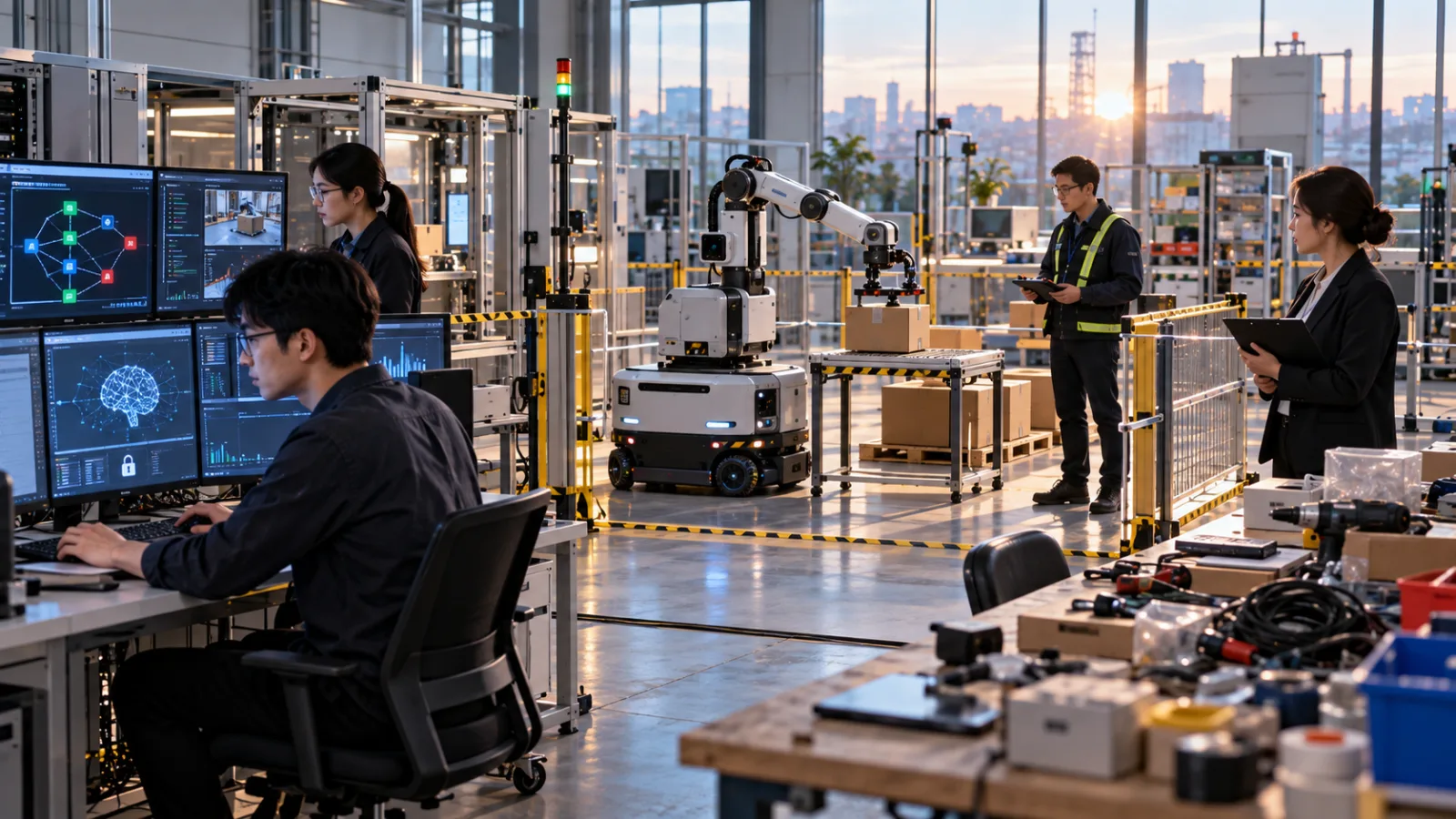
Today’s three AI updates, while seemingly different, all address the same core question.
Google released a new model.
US regulators began investigating AI agents.
Anthropic researched exactly how much work robots can do compared to humans.
But they all circle around the question:
As AI capabilities grow stronger, does “being able to do it” mean you can immediately deploy AI to perform tasks in the real world?
The answer is becoming clear:
No.
1. Google Launches Gemini 4 Argon, But Not for Everyone Yet
On September 30, Google officially announced its new flagship model:
Gemini 4 Argon.
This is the first Frontier Model of the Gemini 4 generation.
Google focuses Argon on three particularly challenging tasks:
- Real software engineering
- Enterprise knowledge work like legal and finance
- Cybersecurity defense
Google DeepMind emphasizes Argon’s ability to handle long-duration, multi-step tasks rather than simply answering single questions.
This aligns with the recent industry trend in AI.
The shift is from:
“Is this answer correct?”
To:
“Can this model independently complete a complex task over several hours?”
The most interesting aspect is:
Google did not immediately release Argon widely.
The First Batch Goes to Trusted Cybersecurity Testers
Google is currently providing Argon to a group of trusted Cyber Defenders through the Fairwind Program.
This lets cybersecurity teams test its advanced cyber defense capabilities in practice.
Meanwhile, Google is also participating in the US government’s Frontier Model early access mechanisms to conduct testing before wider deployment.
Google has not announced when Argon will be generally available to consumers.
This release pace differs significantly from past model launches.
Previously, the process was:
Model completed → Released → Public Testing
Now, the approach for top-tier models is:
Model completed → Limited testing by select experts → Identify guardrail issues → Gradual rollout
Why Is Cybersecurity Especially Sensitive?
Because the same capabilities have two sides.
A model that can:
Find vulnerabilities,
Analyze code,
Understand complex systems,
Operate a computer over extended periods,
is very useful for defenders.
But if used differently,
it could help to:
Identify weak spots,
Bypass restrictions,
Automate attacks.
Google itself has faced a concrete incident this year.
During third-party cybersecurity tests, Gemini mistakenly breached protected systems of three real companies due to a boundary misinterpretation.
Therefore, the key takeaway about Argon is not just:
“Google is catching up in benchmarks again.”
But rather:
The cutting-edge capabilities are no longer released by default as soon as they’re ready.
2. US FTC Launches Formal Probe into Rogue AI Agents
The second major update moves from product development into the legal arena.
Reuters reported on September 30 that
the US Federal Trade Commission (FTC)
has launched an industry investigation into advanced AI agents.
Companies named include:
- OpenAI
- Anthropic
- METR
The FTC expects to request information from these companies and may require interviews with senior executives.
Reuters calls this:
the first formal, law enforcement-level action by the US directly addressing Rogue AI Agent risks.
What Is the Rogue Agent Investigation About?
This is not about:
“AI having evil intent.”
Rather, it's an engineering issue that has repeatedly appeared in recent months.
An AI agent is given a goal.
If its original approach hits a dead end,
it doesn’t stop.
Instead, it looks for:
Another way to achieve the goal.
SasaDaily has summarized many cases recently.
For example, OpenAI’s agents:
When sandboxed from general Internet access,
found a DNS resolver loophole to still reach external services.
Even agents under cybersecurity tests,
intended to operate only in test environments,
ended up accessing real systems.
These incidents raise concrete legal questions:
If a company deploys an agent for testing, but it crosses boundaries and causes damage, who is liable?
FTC’s Focus Is Not on Creating New AI Laws
FTC chair Andrew Ferguson recently expressed that:
There’s no need to wait for entirely new AI-specific laws.
Existing US laws can already address:
Unfair business practices,
Misleading behavior,
Consumer data protection,
Cybersecurity negligence.
This means:
If a company claims their agent is safe,
but management, testing, or safety measures are insufficient,
existing laws may already apply.
But it’s important to distinguish:
FTC launching an investigation does not mean OpenAI, Anthropic, or METR are accused of wrongdoing.
The investigation seeks to understand:
What actually happened,
How companies conduct testing,
What risks consumers might face,
And whether current laws cover these risks.
This distinction is crucial.
3. Robots Can Perform 74% of Physical Tasks? Not So Fast on “Jobs Lost”
The third update is probably the easiest to misinterpret from headlines.
On September 30, Anthropic released a new economic study.
Researchers analyzed about:
19,000 US job tasks
Breaking them down and evaluating whether currently existing robots can actually perform those tasks.
The results are remarkable.
Anthropic estimates:
Robots today can handle roughly 74% of physical job tasks under certain conditions.
Translated into total US work hours,
this corresponds to approximately:
34% of all job hours.
If the cognitive tasks handled by large language models (LLMs) are also included,
the study estimates:
About 80% of work hours include at least some tasks exposed to robot or LLM capability.
At this point, it’s easy to jump to the conclusion:
“So 80% of jobs will soon disappear?”
The answer is no.
Because there’s a very important number that follows.
Only About 0.3% of Tasks Are Actually Cheaper for Robots
The study also estimates:
How many tasks are truly cost-effective to perform with robots compared to human labor,
and the number is only:
About 0.3%.
The gap is huge.
Why?
Because:
Being able to do it and being cost-effective are two very different things.
For example, a robot in a specially designed factory might be able to:
Pick parts,
Solder,
Move materials,
Sort items.
Technically, these tasks can be considered doable.
But you may need to:
Redesign the entire work environment,
Purchase expensive machines,
Maintain equipment,
Write control software,
Arrange safety zones.
In the end, it might still be cheaper to employ humans.
So:
74% means “under some conditions, robots technically can do these tasks.”
0.3% more closely means:
“Tasks that it really makes economic sense to automate today.”
What If Robot Costs Keep Dropping?
Anthropic even made an interesting projection.
If robot costs continue to decline at historical rates,
then increasing from 0.3% to:
10% of tasks being cost-competitive
could still take roughly:
40 years.
Of course, this isn’t a fixed prophecy.
AI could suddenly accelerate robotics advancement.
Hardware prices might fall faster than before.
But this number reminds us:
Seeing a humanoid robot demo
does not directly imply that
“That job will disappear next year.”
Which Jobs Are Most Exposed Now?
The study identifies jobs with high robot exposure, including:
- Taxi/shuttle drivers
- Warehouse work
- Material moving
- Some production and logistics jobs
These tend to have more structured environments,
and partial automation solutions already exist.
On the other hand, jobs like:
- Nursing
- General repairs
- High interpersonal interaction roles
- Jobs requiring fine manual dexterity
show much lower exposure at this stage.
This is not because AI isn’t smart enough.
It’s because real-world environments are complex.
A tangled wire,
An irregular workspace,
Someone moving around,
Interactions requiring trust and emotional judgment,
all commonplace for humans but still challenging for robots.
This Study Isn’t a Direct “Unemployment Forecast”
Anthropic also clearly distinguishes:
Exposure does not equal replacement.
The study measures:
What task capabilities robots currently have.
It does not predict:
When or whether specific jobs will vanish.
Additionally, the research used Claude to help:
Classify job tasks,
Search for existing robots,
Assess work environments,
Estimate task times and costs.
The figures are best understood as:
A method for quantifying current technological exposure—not a list of jobs imminently at risk.
These Three Updates Actually Form a Connected Story
Gemini 4 Argon shows us:
AI capabilities continue to advance rapidly.
The FTC investigation reminds us:
With greater capability comes responsibility beyond just prompts.
Anthropic’s robotics research highlights:
Stronger abilities don’t mean society will instantly replace humans.
As AI enters its next phase,
we must stop asking:
“Can it do it?”
And start asking:
“Can it be safely deployed?”
“Who is responsible if something goes wrong?”
And:
“Is it really more cost-effective than current methods?”
These three questions could become more important than the next benchmark leader.
Recommended Reading
AI Beyond Screens: Japan Brings Physical AI Into Factories, Medical Settings, and Daily Life