Let's clarify upfront:
This is a hypothetical business case by SasaDaily.
It does not reflect the actual savings of any company that has adopted such robots.
What we want to demonstrate today is:
When a small company sees AI robots becoming more capable, how should they judge:
"Is this step really worth automating?"
Because a recent study revealed some very interesting figures.
Anthropic estimates that currently existing robots can handle about:
74% of physical work tasks under specific conditions.
But when factoring in real costs, only about:
0.3% are actually cheaper than human labor.
The big gap between these two numbers highlights:
Being able to do it doesn’t mean it’s worth doing.
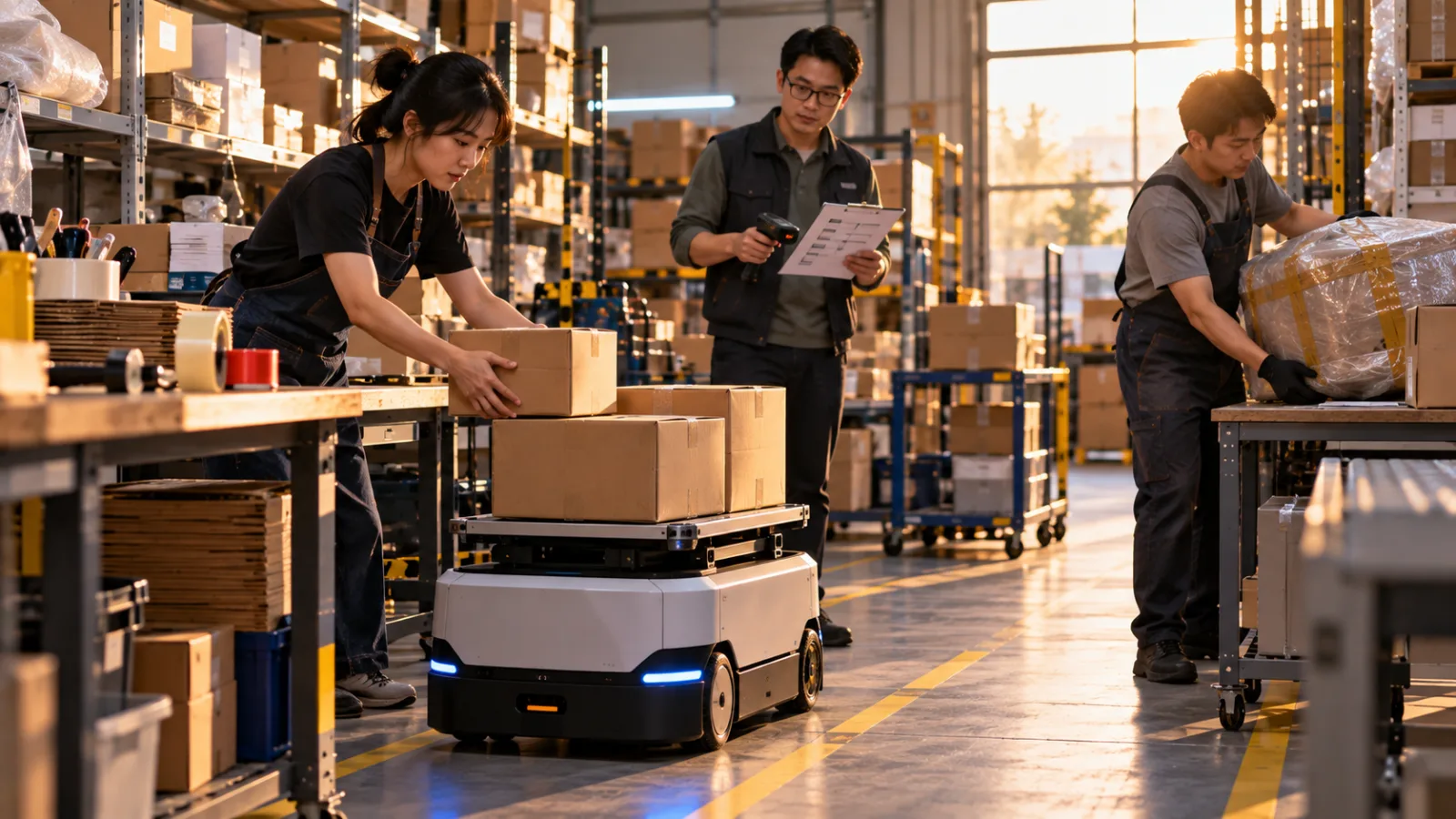
Assuming this is a 5-person e-commerce warehouse
This company processes website orders daily.
Tasks roughly include:
- Picking items
- Packing
- Moving packages to the shipping area
- Scanning barcodes
- Restocking
- Handling returns
- Managing defective products
- Responding to logistics issues
The owner recently saw many warehouse robot demos.
Robots that can independently move around,
carry boxes,
and avoid people.
The initial reaction is usually:
"Should we buy one too?"
However, that’s the wrong question.
The real question is:
"Which task is worth automating first?"
Step 1: Automate tasks, not entire roles
For example:
There is a simple daily task in the warehouse:
Moving a packed standard cardboard box from the packing table to a fixed shipping area.
This task features:
Fixed route.
Fixed start point.
Fixed endpoint.
Mostly standardized box sizes.
Repeated many times a day.
Requires minimal judgment.
This is more suitable for initial automation testing than:
"Handling the entire warehouse logistics."
Because "logistics" is a broad job category,
while carrying a standard box along a fixed route is a specific task.
Step 2: List out all exceptions first
What often causes automation to fail isn’t normal conditions,
but the exceptions.
This hypothetical warehouse begins listing:
Which boxes can’t be handled by the robot?
Examples include:
- Oversized boxes
- Boxes that are too heavy
- Fragile items
- Irregularly shaped packages
- Returned goods
- Unreadable barcodes
- Temporary blockages in aisles
- Shipping area full
This step is crucial.
Because demos usually show:
Normal scenarios.
But real operations deal with:
Exceptions every day.
So don’t just count:
"The robot successfully moved a box."
Count instead:
Out of 100 tasks, how many still required human intervention?
Step 3: Consider if the environment needs to be remodeled for robots
Anthropic’s research includes an important distinction.
Certain jobs robots can do today
require you to first create an environment tailored for robots.
Such as:
Fixed flooring,
Fixed shelving,
Standardized box sizes,
Clean aisles,
and unchanging work positions.
This differs from humans.
Humans normally just walk around a box blocking an aisle.
Robots may need:
Rerouting,
Stopping,
Waiting for human assistance,
or may altogether fail.
So the warehouse should not only ask:
"How much does the robot cost?"
They must also ask:
"How much will it cost to modify the environment to accommodate it?"
This might include:
- Floor markings
- Charging stations
- Wi-Fi/network upgrades
- Warehouse traffic flow
- Box size standardization
- Software integration
- Safety zones
- Employee operation procedures
All these are part of automation costs.
Step 4: Don’t compare robot price directly to employee salary
Suppose a robot appears to cost a certain amount per year.
You can’t just say:
"It costs less than an employee’s salary, so it’s cost-effective."
The real metric is:
Cost per Successful Task.
That is,
the actual cost to successfully complete one usable task.
You need to include at least:
Robot purchase or lease,
Setup and integration,
Warehouse modifications,
Maintenance,
Downtime,
Software fees,
Staff training,
and time spent by humans handling exceptions.
If a robot runs many tasks per day,
but requires an employee to constantly
restart it,
rescue it,
move obstacles,
or rescan barcodes,
then although it appears to have "high automation,"
it may not actually reduce labor.
Step 5: Automate one route first, don’t overhaul the entire warehouse
A small company’s sensible approach isn’t:
to go fully automated right away.
But to select:
The route from the packing table to the shipping staging area.
In the first phase, only handle:
Standard cardboard boxes.
Other items, like:
Oversized items,
fragile goods,
returns,
and exceptional orders,
remain handled by humans.
This way you can understand:
Whether "the robot can’t do it,"
or "the task selection was wrong."
The five key numbers to track during testing
Don’t just film the robot running smoothly.
At minimum, record:
1. Number of successful tasks
How many actually go from start to finish without human aid?
2. Human intervention rate
Out of every 100 tasks, how many need human help?
3. Actual labor time saved
Not how long the robot ran, but how much less time humans worked.
4. Downtime and maintenance time
How many hours per week is the robot non-operational?
5. Total cost per successful task
Include all equipment, system, and human support costs.
Only then can you decide:
Whether this automation is worth keeping.
If results are disappointing, it doesn’t mean the robot is bad
Suppose testing shows:
The robot can move boxes,
but costs do not decrease.
There are three possibilities:
First:
The task frequency is too low.
If it only needs to move boxes about a dozen times daily,
there isn’t enough work to amortize equipment costs.
Second:
Too many exceptions.
Box sizes vary frequently,
aisles are constantly blocked,
and shipping areas change often,
leading to high human intervention rates.
Third:
The cost of modifying the environment for automation is too high.
In these cases, the best decision might not be:
Investing in a more expensive robot.
But rather:
Temporarily not automating this step.
Stopping an unprofitable AI project is a good decision on its own.
That’s the real difference between 74% and 0.3%
Anthropic’s study does not say:
74% of physical tasks can immediately replace humans tomorrow.
It means more like:
Some existing robots can perform these tasks in certain environments.
But once you factor in:
Cost,
environment,
exceptions,
human preferences,
regulations,
maintenance,
and reliability,
only about:
0.3% of tasks today are actually cheaper than humans.
This is often overlooked by businesses adopting physical AI.
Small companies should not start with "which robot to buy"
Large companies can:
Build new plants,
redesign production lines,
revamp the entire logistics system,
and deploy many devices at once.
Small companies usually can’t do this.
So a better sequence is:
Identify the most consistent step in the work process first.
Then ask:
Is it high frequency?
Is the environment stable?
Are there many exceptions?
Can humans quickly take over when failures occur?
Only then ask:
Is there a robot worth buying?
Not the other way around.
The ideal outcome isn’t full automation
The truly ideal scenario for this 5-person warehouse
isn’t robots completely replacing people.
More likely is:
Robots handle high-frequency, standardized, fixed transportation tasks.
People handle:
Exceptions,
judgments,
exceptional orders,
customer needs,
and process improvements.
The true goal of automation isn’t:
"Can we reduce the workforce further?"
But rather:
"Which repetitive task can we hand off to robots so humans can focus on more complex work?"
If you want to find out which part of your work process is best to automate with AI first, comment "process."