No, it doesn’t.
Gemini Notebook has a very practical design feature:
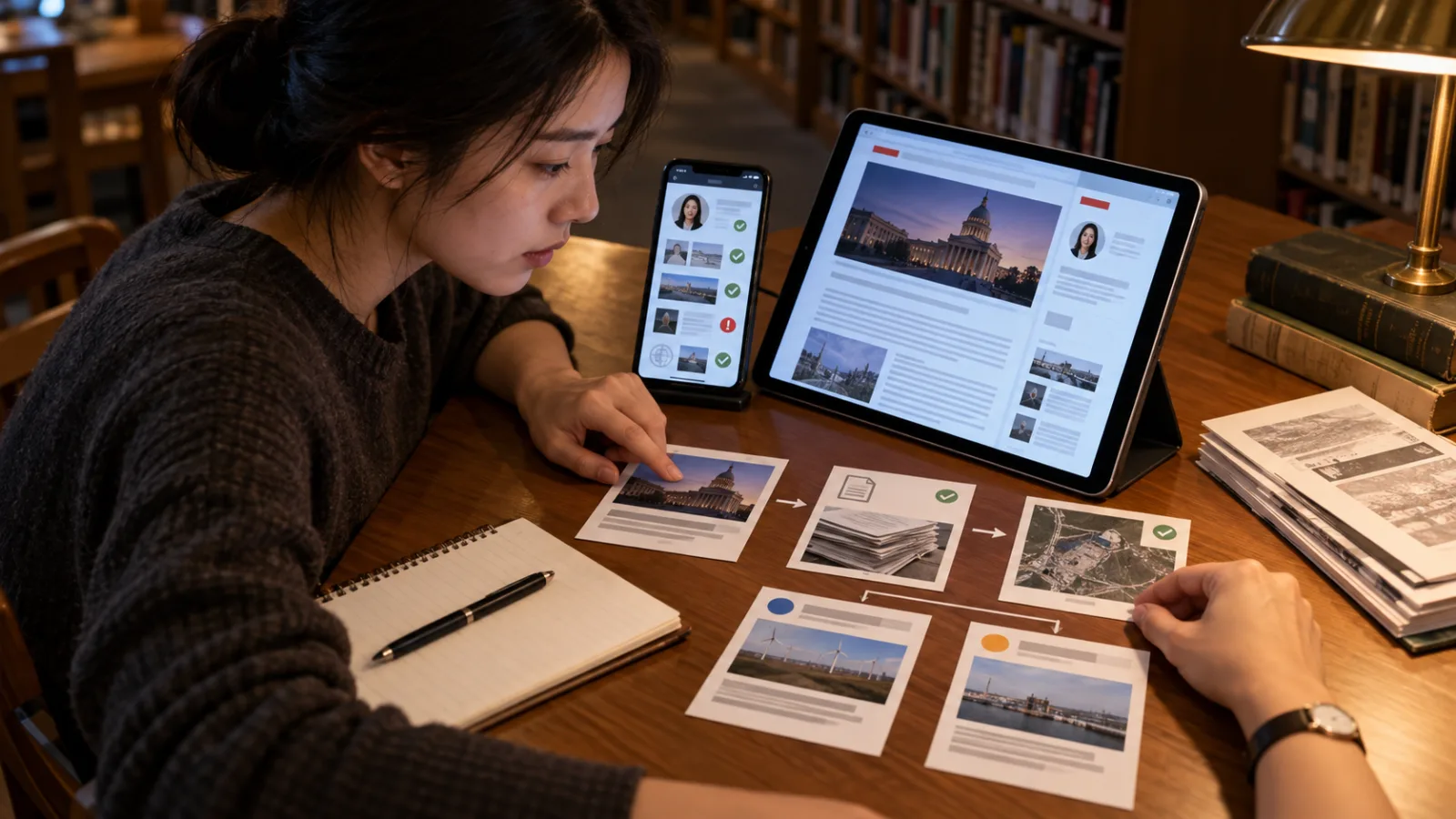
Answers come with citations indicating source references.
Hovering your mouse reveals the cited content.
Clicking allows you to jump directly to the source location and view the surrounding context.
This naturally leads to an intuition:
If AI provides citations, the answer should reflect the author’s original intent, right?
Not quite; there’s one more step.
Citations tell you:
Part of the AI’s answer can be traced back to the source.
But they can’t automatically prove:
The entire conclusion formed after AI’s synthesis matches exactly what the author meant.
Why can answers still have issues even if citations are real?
Imagine a book has three passages.
The first says:
“Managers should first understand why employees made mistakes.”
The second says:
“Ongoing problems require clear feedback.”
The third says:
“In certain situations, work methods need to be rearranged.”
Gemini Notebook might summarize these into:
“The author suggests that when employees repeatedly err, managers should first understand the reasons, then provide feedback, and finally rearrange work.”
Each part might have citations nearby.
It looks very complete.
But upon reviewing the original book, you might find:
The third passage actually discusses a completely different situation.
The author never wrote these three steps as a fixed process.
In other words:
Each piece of material might be true.
But the way AI connects them may include its own organization and inference.
What exactly do citations prove?
The simplest way to understand it is:
Citations are more like:
“You can start your fact-check here.”
Not:
“This entire sentence is personally certified by the author.”
Google’s official explanation of Gemini Notebook is:
The system uses text and images from the source directly to build citations.
You can view the cited content.
You can also jump back to the source to see the full context.
Google states that citations help users check the accuracy of the response.
That means:
They assist you in verifying if the answer is accurate.
Note the order here.
It’s not:
“There is a citation, so no need to check.”
Rather:
“Because there is a citation, checking becomes easier.”
Error type 1: Citation supports the first part, but not necessarily the latter
For example, AI answers:
“The author thinks employees need clearer feedback, so managers should hold weekly one-on-one meetings.”
Checking the citation shows:
The original says employees need clear feedback.
But it doesn’t say there must be weekly one-on-one meetings.
The latter practice may be AI’s own deduction based on common management knowledge.
Here, it would be wrong to write:
“The author recommends weekly one-on-ones.”
A more accurate statement is:
The author emphasizes clear feedback.
The weekly one-on-one is AI’s possible suggested approach.
Keep these two separate.
Error type 2: AI omits the author’s limiting conditions
The original might say:
“When employees have received adequate training but problems persist, adjusting job responsibilities is possible.”
AI might summarize:
“When employees repeatedly make mistakes, their work can be adjusted.”
They seem similar.
But this misses the important condition:
Adequate training has been completed.
The author’s original point isn’t:
Mistake → Adjust work.
It’s:
Training completed.
Problem still exists.
Then consider next steps.
Looking only at the AI summary could make the meaning stronger than the original.
Error type 3: AI turns author’s examples into rules
A book might write:
A company increased efficiency after reducing weekly meetings to 30 minutes.
This is just a case study.
AI might summarize as:
“The author recommends limiting weekly meetings to 30 minutes.”
This common difference is:
Example does not equal principle.
The author describes:
Someone did this.
That doesn’t mean the author advocates:
Everyone should do it.
Seeing a citation, you should ask:
Is this passage:
Presenting a principle?
Describing a case?
Citing research?
Making a conjecture?
Or just giving an example?
Error type 4: Several individually correct citations combined might not be correct together
This is especially important for Expert Intelligence.
Because now we’re not just asking AI to find one sentence.
We might ask:
“According to this book, how should I solve my company’s current pricing problem?”
AI must gather from:
Chapter 1.
Chapter 5.
Chapter 10.
Select different content and recombine it.
This is exactly the most valuable role AI plays.
But also the area where judgment is most needed.
Citations can prove:
These building blocks come from the book.
But they can’t necessarily prove:
The author himself would assemble these blocks in exactly this way.
Do I have to check the book for every sentence?
For general learning, it’s not necessary to be so exhaustive.
You can use risk grading.
If you’re just asking:
“What are the three main points in this chapter?”
Simply verifying whether citations roughly match is enough.
But if you plan to:
Reference the answer in an article as the author’s view,
Write a research report,
Set company policies,
Change prices,
Handle health matters,
Make important decisions,
You should take an extra step:
Open the citation and review the context.
The more important the use,
the bigger the difference between
“Roughly right”
and
“What the original author truly advocated.”
Can I directly write “The author said”?
If you’re only referring to Gemini Notebook’s summary,
it’s best not to do so yet.
First click the citation.
Confirm the original text.
Especially when you’re about to write:
“The author believes…”
“The author argues…”
“This book suggests…”
Because this is no longer:
Your own understanding of the book.
But rather:
You are attributing a viewpoint to a specific real author.
The standard should be higher.
The safest process is:
AI tells you where it possibly is.
You go back to the original text.
Confirm the full context.
Then decide how to paraphrase.
What if the same answer has five citations?
More citations don’t necessarily mean more accurate.
Five citations mean:
AI found five possibly relevant source locations.
The real check is still:
How directly each source supports the nearby claim.
For example:
All five passages only discuss “feedback is important.”
Yet AI concludes:
“The author established a five-step manager feedback system.”
Even if five citations are given,
You should verify:
Does the original book really have a five-step system?
Or did AI help organize the five steps?
If the latter,
You can say:
“Based on different chapters, I organized it into five steps.”
Not:
“The author proposed five steps.”
This is much clearer.
Does Gemini Notebook fetch internet data on its own?
If you ask within the Gemini Notebook chat itself,
Google currently says:
Responses are exclusively grounded in your notebook sources.
Meaning the answers are based on notebook sources.
You can also select which sources to use for a specific question via checkboxes.
But there’s an important distinction.
The same notebook, when accessed via Gemini App or in AI Mode,
does not use exactly the same answering mechanism.
Google explains:
Gemini App and AI Mode may also use Web Search or other tools in addition to notebook sources.
So when you see:
“This is my notebook.”
Don’t automatically assume the grounding rules are the same across all entry points.
What’s different about today’s Expert Intelligence?
After Google launched Expert Intelligence on August 27,
eligible eBooks purchased through Google Play Books can become Gemini Notebook sources.
Google clearly states:
You can ask questions about the book, and responses will be directly grounded in that book.
They can also be used alongside your own data.
This makes tracing “what the author really said” easier than with general chat AI.
But grounded doesn’t mean:
AI doesn’t need to do any summarizing.
AI may still:
Summarize.
Compare.
Merge.
Generalize.
Reorganize.
And these actions involve interpretation.
The best approach is not to distrust AI,
but to understand:
Which parts are sourced, and which parts are AI’s synthesis.
What’s the simplest way to verify?
When you see an important conclusion, ask three questions:
First:
Does the citation really convey that meaning?
Second:
Are any conditions in the full context omitted?
Third:
Is this the author’s own conclusion, or one that AI formed by combining several parts?
If it passes all three,
You’re more confident saying:
“This truly reflects the author’s viewpoint.”
Is having citations worth it?
Absolutely.
Without citations,
AI says:
“The author believes…”
You probably don’t even know where to verify.
With citations,
You can access the original text in seconds.
Citations greatly improve:
Transparency.
Verifiability.
And your chance to catch AI’s misinterpretation.
But their real value is not:
To replace verification.
On the contrary,
It makes verification much cheaper and easier.
Final thought
Gemini Notebook citations prove:
There is a traceable source for the answer.
But to prove:
The author truly meant this,
You must check:
What exactly the citation supports.
AI can help you read books faster.
Citations help you find the original text faster.
But understanding the author
still requires more than just looking at the small blue number by the citation.
You need to see:
What the original text behind that number actually says.
Today, let’s improve with AI.
Learn one AI tip every day.
Save a little time every day.
Enhance your skills a bit every day.
SasaDaily, growing with you.