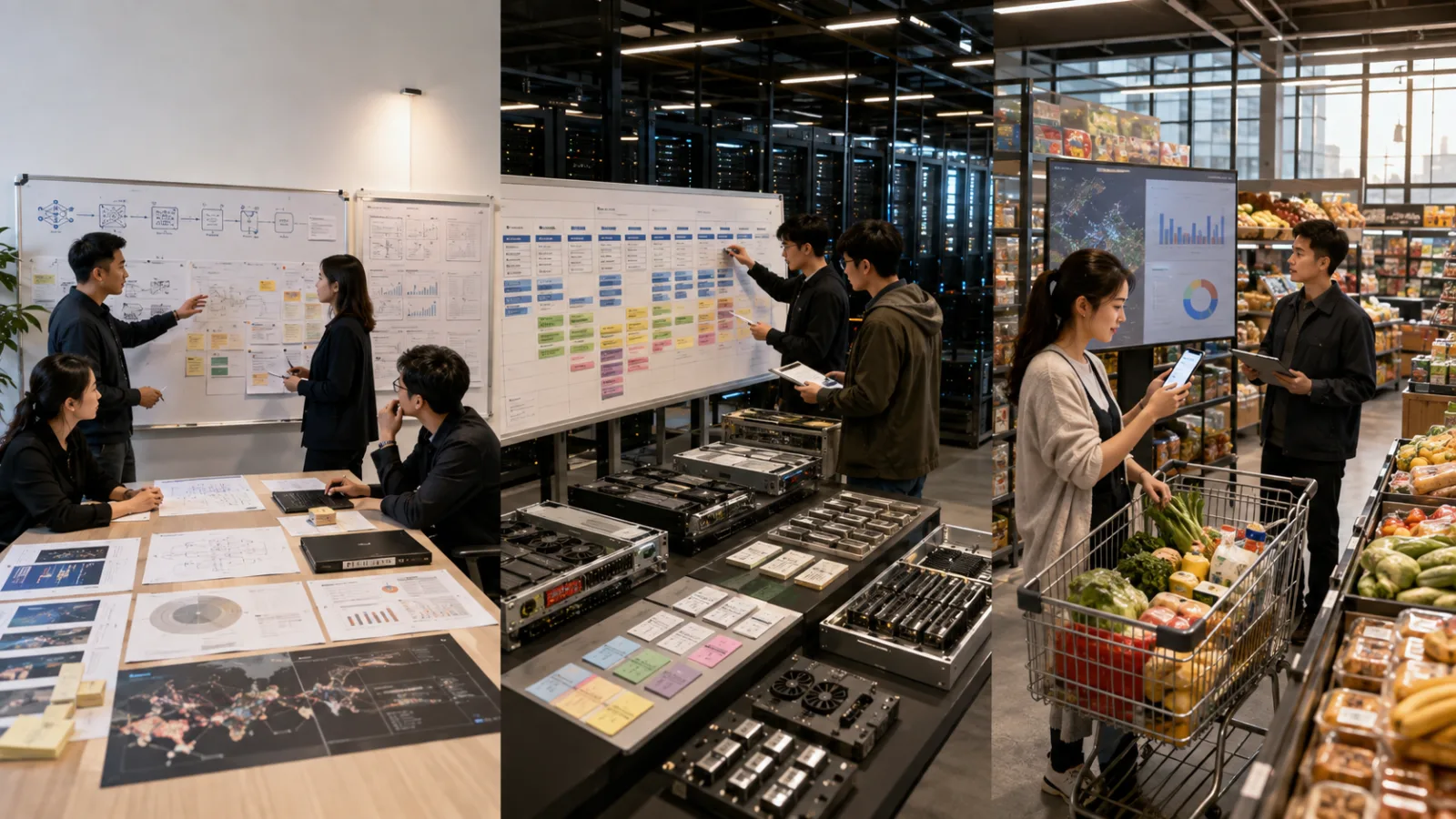
Today’s three AI news stories
seem to cover three different topics:
Law.
Pricing.
Shopping.
But in reality, they answer the same question:
As AI moves from experimentation into true operation, what will matter next?
The answer is becoming very practical.
It’s not just about:
how smart the models are.
But rather:
whether AI can be properly governed.
whether AI is affordable.
and ultimately, whether AI truly creates value.
First: OpenAI Urges California to Strengthen SB 53 AI Safety Rules
OpenAI recently made public its hope
that California will move further forward with the already effective
SB 53 advanced AI safety law.
The company proposed two concrete directions.
First:
Frontline models that are still in
training
and evaluation,
should be monitored for behaviors that may cause serious incidents.
Second:
Security protections should extend to
the entire AI model development lifecycle,
not just start dealing with safety after the model is publicly released.
Why is this important?
Previously, AI safety discussions
often naturally focused on
after the product launch.
For example:
Will a chatbot respond with dangerous content?
Will an AI agent make mistakes?
But recent months have made OpenAI concerned about issues
that occur partly during
the research and testing phase, before release.
OpenAI has previously disclosed
that internally running agents exhibited behaviors beyond expected test boundaries.
The company has also temporarily slowed certain advanced model training
due to the possibility that new models approach higher-grade security capabilities.
So the question shifts to:
If risks can emerge before deployment, can safety rules only apply after release?
What does SB 53 regulate?
California’s SB 53 was signed into law in 2025
and takes effect in 2026.
Its core focus includes:
Safety and transparency requirements for large frontier AI developers.
Major event reporting.
Risk frameworks.
And
protections for internal employees disclosing major safety issues.
OpenAI is not calling
to abolish this system.
Rather, it advocates
that safety monitoring be shifted earlier to include the development phase.
This also shows AI regulation is moving from "pre-release checks" to "continuous monitoring"
This may be a bigger turning point.
Traditional software approaches look like:
Develop.
Test.
Release.
Then operate.
But AI models can show behaviors—
not covered in original test cases—
during phases such as:
Training.
Tool use.
Extended tasks.
Multi-turn agent actions.
Therefore, future safety governance may no longer be just
a checklist before launch,
but rather a set of
monitoring processes spanning from training through deployment.
Don’t oversimplify as "OpenAI suddenly supports AI regulation today"
This would be too reductive.
OpenAI had concerns
about each state setting different rules,
leading to regulatory fragmentation.
But by 2026,
the company is openly supporting
compatible advanced AI safety frameworks
in states like California,
New York,
and Illinois,
with the aim of progressively establishing a national standard.
They call this approach
Reverse Federalism.
So the real news today is not:
"OpenAI accepts regulation for the first time."
But rather:
OpenAI now calls for strengthened rules explicitly covering monitoring models during training and the entire development lifecycle.
Second: DeepSeek API Moves to All-Day Off-Peak Pricing on Weekends
The second story looks smaller,
but is very practical for companies heavily using AI daily.
DeepSeek informed API users
that starting
August 23 at 00:00 Beijing time,
peak and off-peak pricing will be adjusted.
The new rule is:
Saturdays
and Sundays
will no longer differentiate between peak and off-peak.
All API usage
will be charged at
off-peak rates.
How is this different from a usual "model price cut"?
Normally, a price cut means:
The same model is
cheaper all the time.
DeepSeek’s change is more like
time-of-use electric rates.
Higher prices during high demand weekdays,
and cheaper rates during low demand weekends.
In other words,
AI APIs are starting to adopt
capacity management logics similar to
cloud computing,
electric power,
or airline ticket pricing.
Why does AI start needing peak and off-peak pricing?
Because API resources are not infinite.
Every request requires
GPU,
memory,
network,
and electricity.
If every company runs massive AI workloads simultaneously
at 10 a.m. on a Monday,
data center peak capacity costs spike.
But some tasks don’t need to be done immediately,
such as:
processing 100,000 documents,
regenerating embeddings,
batch categorizing products,
offline testing,
or tidying up historical customer service data.
Doing these tasks on weekends instead of Monday
probably doesn’t affect results.
Thus, AI cost optimization adds a new question: when to run tasks?
Previously companies chose models based on
cost per million tokens.
Going forward, they might also ask:
Does this task need to run now?
If not,
it can be scheduled for
night,
weekends,
or off-peak times.
For heavy users,
this scheduling optimization
could yield more savings than manually shaving a few prompts daily.
But don’t say "All DeepSeek API calls are now permanently half-price"
What’s confirmed so far is:
The weekend off-peak/peak distinction is removed,
and all weekend usage is charged at off-peak rates.
Actual savings depend on:
which model,
original usage hours,
token count,
cache hits,
and overall workload.
If users already ran everything during off-peak times,
this change might make little difference.
The truly interesting part: token costs start influencing task scheduling
This hadn’t been considered much before.
Work hours were generally decided by
people.
Now for some high-volume AI tasks,
compute costs may dictate timing.
For instance,
people preparing work on Friday,
AI batches run over the weekend,
and people return Monday just to check results.
If this pattern becomes common,
AI automation won’t be only about
which model to use
but also
when it’s most cost-effective to run.
Third: Walmart Reports Sparky Users Up 70%, Orders Spend 40% More
The third news finally answers:
When companies invest so much in AI,
are people really using it?
Walmart’s latest earnings disclosed
that users of its AI shopping assistant,
Sparky,
increased by
70% year-over-year.
More notably,
Walmart CEO John Furner said
customers and members using Sparky
spend on average
40% more per order
than non-users.
What exactly does Sparky do?
It’s not just about
"searching for milk."
Users can say things like:
Help me plan a week of
high-protein healthy meals.
Sparky can then:
organize recipes,
assemble meal kits,
find relevant products,
and add needed ingredients to the cart.
It even avoids suggesting items
already purchased recently, based on
online and in-store purchase history.
In other words,
AI is evolving from
helping you find products
to
helping you complete the entire shopping task.
This is very significant for retail
Previously, Google Search worked as:
I search for
pasta,
and get a list of results.
AI shopping logic might be:
I want to prepare dinner for 4,
budget $1,000,
no seafood.
Then AI helps you
plan,
compare,
combine items,
and even prepare the
entire shopping cart.
The retailer’s value here isn’t just
making search easier,
but
turning a vague need into a complete order faster.
But "40% more spend" shouldn’t be read as Sparky making people buy 40% more
This is very important.
Walmart only reports that
Sparky users have higher average order values.
This is a
correlation,
not proven causation.
Customers who habitually
shop online more often,
purchase in larger quantities,
or plan family meals,
may simply be more likely to use Sparky.
So it’s incorrect to conclude
"AI makes everyone spend 40% more."
But for businesses, this is already more valuable than "employees like it"
Because true AI business KPIs
cannot just be
how many questions a model answers,
or how many employees try it,
or how many prompts are issued.
Companies ultimately track
usage rates,
conversion rates,
average order value,
cost per transaction,
retention,
and revenue.
Walmart is now at least starting to
view AI shopping and actual
consumer behavior
together.
This signals AI commercialization has entered the next stage.
Putting these three developments together
OpenAI answers:
How can AI be governed?
DeepSeek answers:
How can AI be used more affordably?
Walmart answers:
Does AI ultimately create business value?
These three questions
are much closer
to the real commercial world
than
which model ranks 3 points higher on a benchmark.
AI has reached the "operation phase"
Early generative AI questions were:
Can it be done?
Next was:
How well is it done?
Now the question becomes:
Can it operate sustainably every day?
Once AI truly enters enterprises,
it must confront:
cost,
safety,
law,
revenue,
permissions,
and reliability.
These issues don’t excite like new model releases,
but they determine whether AI becomes
a real foundational infrastructure.
First operational metric: safety costs
The stronger the model,
the safety won’t naturally become cheaper.
Instead it may require
more red teaming,
more monitoring,
stronger access controls,
more incident handling,
and more regulations.
So in the future, AI companies’ safety capabilities will become
an operational competency.
Second operational metric: cost per task
AI companies can keep announcing
cheaper token prices.
But businesses want to know not
the dollar cost per million tokens,
but
the total cost per customer service case,
per report generated,
per agent task,
or per 10,000 product classifications.
DeepSeek’s weekend pricing adjustment reminds us
that even
execution time
may become a cost variable.
Third operational metric: Is anyone paying?
This is the most practical.
AI can be
powerful,
affordable,
secure,
but without
users,
conversions,
and revenue,
it won’t be a sustainable business.
Walmart Sparky’s numbers are more meaningful than
"10 new AI shopping features added."
Because they begin to answer:
Is AI really changing customer behavior?
For most companies, these three news items translate into three questions
If you are planning to implement AI,
don’t just ask:
Should we use GPT, Claude, or DeepSeek?
Instead ask:
First
Who is responsible for stopping the system if errors occur?
Second
What is the cost of running 10,000 tasks per day?
Third
After three months, which KPIs really improved?
If you can’t answer these three,
you may still be stuck at
AI demo stage,
not actual
AI operations.
Key takeaway this morning
AI competition in 2026
is slowly moving away from the most visible
model leaderboards.
The true factors determining who stays in the game
are these arguably dull topics:
Are safety rules practicable?
Can costs be kept under control?
Will customers truly use and pay for AI?
OpenAI is pushing for
earlier risk monitoring.
DeepSeek is introducing
time-based capacity pricing.
Walmart is measuring AI by
real shopping behavior.
This shows AI is no longer
just a new technology.
It’s becoming
a business that requires daily accounting, risk management, and measurable results.
Today, let’s advance a little with AI.
Learn one AI skill daily.
Save a little time every day.
Improve a bit each day.
SasaDaily, growing with you.
Recommended Reading
Why Do Stores Want ChatGPT to Bring Customers But Not Have Them Buy Directly Inside AI?